Saturday, July 18, 2009

Fix My Station... Revisited


Three years ago, the Commuter Council launched the “Fix My Station” campaign, calling on Governor Rell to fix the crumbling, dilapidated and often-times dangerous conditions at CDOT-owned rail stations from New Haven to Greenwich.

Commuters sent in dozens of photos of their stations showing exposed wires, mold and graffiti which we posted on our website. Months later, CDOT finished a careful station by station engineering analysis recommending not just repairs but improvements. Special funds were allocated by the legislature for the needed work. Then… nothing happened.

Once again, we’d identified a problem, studied it and issued reports… and assumed the job was done. Few, if any, repairs were ever made to stations. If we were to revisit the same stations today we’d find things little improved.

But then, along came the Federal government this year with its “stimulus money” to create jobs with “shovel ready” public works projects.

Regional planners moaned, caught in a classic “Catch 22”. Because they had not been allowed for decades to plan for work that wasn’t already funded, there was little work that was truly “shovel ready”… except, in Connecticut’s case, at the train stations.

Here’s what happened at one station… Noroton Heights in Darien… but is doubtless being replicated across the country with similar public works projects.

One of the problems indentified at Noroton Hts as far back as 2004 was two sets of crumbling concrete steps leading from the west end of each platform up to Hollow Tree Ridge Road. Each set of stairs contains 28 steps.

Town officials initially estimated the repair work would cost $225,000, and the repairs were ordered, pending accumulation of enough money from parking revenues from commuters to pay for them.

Then the CDOT got involved. Because the steps were close to the track and overhead catenary power lines, CDOT said that Metro-North “flag men” would be required to oversee the repair work. That would add $80,000 to the job.

Because of the delays and since building supplies were then in such demand, prices escalated and the final bid for the work topped $400,000.

Then, along came Uncle Sam. When the feds dumped billions onto the states, somehow Hartford decided that $1.6 million should be spent at the Noroton Heights rail station. This would mean that in addition to fixing the steps, platform canopies could be extended and the platforms themselves could be resurfaced… projects long dreamt of but never put to paper by planners.

But be careful what you wish for.

Because Federal funds were now involved, CDOT had to revisit the stair rebuilding to be sure the work met Washington’s standards, not just Darien’s or the state’s.
Now, $30,000 will go to CDOT just to administer the project. But because CDOT is now under-staffed thanks to recent layoffs and early retirements, they can’t administer the job. The work is delayed again and the stairs probably won’t be repaired until 2010, six years after they were first identified as needing the work.

Had the Federal stimulus money gone directly to the towns, work would probably be underway by now. Heck… with a crew of Boy Scouts, a few sledge hammers and some local contractors, the steps could have been fixed in one week summers ago!
Instead, the steps are still crumbling. Federal funds are not being spent. Jobs have not been created. And another summer construction season will probably be wasted.

The “Fix My Station” campaign seemed like such a great idea three years ago, but those were simpler times and I was probably naïve to think anything so important could ever be done so quickly and easily. After all, this is Connecticut.

Tuesday, July 7, 2009

Getting To The Airport

They used to say that “getting there is half the fun”. Whoever “they” were, they haven’t endured the challenges and indignities of air travel post-9/11.
Even getting to the airport can sap your strength, if not your wallet. Consider the alternatives.

A car service is certainly convenient. But at $160 one way to LaGuardia’ $170 to JFK and $200+ to Newark, getting to the airport can cost more than your air fare. (Mind you, these are the advertised rates, so I wouldn’t be shy about asking for promotions and discounts when you call to book.)

But car services aren’t just expensive, they’re also wasteful. Couldn’t solo travelers share a car with others in a “limo-pool”? Is one passenger in a Lincoln Town Car an efficient use of limited space on I-95?

How about Connecticut Limousine? Now there’s a misnomer! Since when is a bus or cramped van a limo? And try explaining that name on the receipt on your expenses to your company’s accountant. “Really boss… it was just a bus!”

On a few occasions I’ve actually rented a car at the airport, driven home and then dropped the car the next day in Stamford. A day’s car rental is about half the cost of a car service. OK… so call me cheap.

Some regular fliers hire neighborhood teens to drive their own car to the airport, drop them off and drive home, repeating the process on their return. That’s cheaper than a car service, but puts double the miles on your car.

My preferred airport transfer is in my own car. Airport parking is $33 a day. Not cheap, but certainly convenient. And nobody complains about my cigar smoking enroute to the airport.

Another alternative, believe it or not, is Metro-North. Get off at 125th Street and catch a cab or livery and you’re at LaGuardia in about 15 minutes. Future plans call for some Metro-North trains to travel over the Hell’s Gate bridge, through Queens and into Penn Station. That could be a great chance to add a LaGuardia station with shuttle bus service to the terminals. But it’s a rail link our kids might see in their lifetimes, not ours.

If you’re heading to Newark, definitely consider Amtrak. Most Northeast corridor trains stop at Newark Airport where a convenient connection to the airport monorail has you at the terminals in just minutes. The train sure beats the Cross-Bronx and GWB any day. And fares are as low as $23 one way.

The proponents of ferry service on Long Island sound keep tempting us with talk about direct water-borne service to LaGuardia, but I’ll believe it when I see it. The old Pan Am Water Shuttle (a high speed ferry) couldn’t make a go of it carrying expense-account business fliers from the Marine Air Terminal to midtown, so I’m skeptical that operators could fill ferry boats to Stamford and Norwalk. And do you really want a sea cruise in the winter?

Mind you, New York’s three airports aren’t the only choices. Westchester County airport offers non-stop jet service to many cities and offers a variety of major carriers including JetBlue. Bridgeport’s Sikorsky airport used to get you to such cities as Philadelphia and Newark, but service now is very limited and expansion of both of these airports is challenged by local residents. Hartford’s Bradley Airport offers another alternative, including low fare carriers like Southwest… if you don’t mind a two-hour drive to get to the airport, north of Hartford.

One reader extols the virtues of New Haven’s Tweed Airport where US Air flies to Philly where you can connect to most anywhere.

Clearly, the trip to and from the airport can start and end a trip on a very sour, and expensive, note. But with a little imagination, this summer’s vacation can end on a thriftier note.

Wednesday, June 17, 2009

Why I hate (and love) Business Rules, part 2

The Two Minutes' Hate is over – the below is a paean of love to HBR.

Prequel to the cool stuff
So in part 1, I reviewed how to create a HBR, substitute in local variables to read a Planning form’s Run Time Prompts (RTP), and suggested that it might be worthwhile to read this post.

The code sample I used doesn’t do any fancy allocation or calculation. It just aggregates the database using form POV members.

You may be scratching your head, thinking, “Why on earth is he banging on and on about this? Just issue an AGG(“Entity”, “Segments”) statement and be done with it.”

Zoiks! If I wrote one line of code to consolidate a database I would be out of a blog post topic – This Is A Bad Thing.

Secondly, Why Would I Want To Do That? (Ex-Comshare employees/customers/partners know of whom I speak when I write that.)

Because thirdly, and most importantly to you, I can make that database aggregate much, much more quickly.

The Trouble with AGG
Other than sounding like a misquote from a sketch in “Monty Python and the Holy Grail”, what is wrong with an “AGG” when applied to the Entity and Segments dimensions?

Think about it in the context of the form as shown below:

If I change any of the data values on this form, I am only changing them for DVD Recorders in Pennsylvania. New Hampshire isn’t in the POV. Neither are eight-track cassettes.

But if I wrote:
AGG(“Entity”, “Segments”) ;
I would be also be aggregating a New England state and a totally obsolete electronic media, if there was any Gross Profit data for those two members. After all, AGG is kind of a blunt axe.


(For you Intelligent Calc lovers out there, yes, I could use the blocks’ clean or dirty status to not calculate upper level data that already exists, but good luck doing that in a real world Planning application. There will be clean/dirty blocks all over the place and it is very difficult to keep this approach from going pear shaped.)

Having disposed of the Intelligent Calc option, while an AGG statement will certainly come up with the right result, Why Would You Want To Do That when you only changed data at the PA and DVD Recorders intersection? Why aggregate data combinations for all of the other level zero Entity and Segment combinations that haven’t even changed?

(These questions do have a point, so bear with me.) You might answer, what else am I to do? How do I consolidate my dimensions if I don’t use AGG or CALC DIM?


Tricky, innit?
Here’s the trick – you don’t need to calculate the dimension, you only need to calculate the relevant hierarchies. That’s what the calc script above shows and what your HBR can do for your forms.


@IANCESTOR is your friend
@IANCESTOR is your BFF? That I couldn’t say. But it’s going to be your HBR pal from now on because, if you think like Essbase, you can make Essbase only calculate what you want. *This* is hacking Essbase.

Let’s review the way Essbase aggregates a database, per our dear friend, the Database Administrators Guide (DBAG). For the below section we’re going to ignore the Consol database to go along with the DBAG. Just substitute Entity for Product and Segments for Market; they are the first and second consolidating sparse dimensions.


How Essbase aggregates a database
Per the ever-scintillating DBAG, Block Storage Option (BSO) databases calculate dimensions in the following order (we are only going to concern ourselves with sparse, aggregating dimensions), “Sparse dimensions (in the order they display in the database outline)”. See http://download.oracle.com/docs/cd/E10530_01/doc/epm.931/html_esb_dbag/dcacaord.htm and the “Member Calculation Order” section if you need to cite chapter and verse.

Okay, we know the order that Essbase is going to calculate the dimensions. What about the order of the members within the dimensions? This is answered by the “Block Calculation Order” section :
“Essbase calculates blocks in the order in which the blocks are numbered. Essbase takes the first sparse dimension in a database outline as a starting point. It defines the sparse member combinations from this first dimension.”

Using My Very Favorite Essbase Database In The Whole Wide World (MVFEDITWWW), i.e., Sample.Basic, this means that:
“In the Sample Basic database, Product is the first sparse dimension…Product has 19 members…Therefore, the first 19 data blocks in the database are numbered according to the calculation order of members in the Product dimension.”

The DBAG goes on to say:
“The other sparse dimension is Market. The first 19 data blocks contain the first member to be calculated in the Market dimension, which is New York…The next member in the Market dimension is Massachusetts. Essbase creates the next 19 data blocks for sparse combinations of each Product member and Massachusetts.”

This is the important bit:
Essbase continues until blocks have been created for all combinations of sparse dimension members for which at least one data value exists.

Guess what, we have just reviewed how Essbase calculates sparse dimensions from the first sparse dimension to the last one, by dimension and within each dimension. In essence, block by block.

In plain English:
1) Product is aggregated for every level 0 Market member (where data exists in Market – Essbase is smart enough not to calculate combinations that don’t exist).
2) Then Market gets aggregated by every Product (that exists, there’s Essbase being smart again).

Okay, but so what?
If we jump back to the Consol database, you may recall that I claimed you don’t need to calculate all of Entity, do you? Nope. Just the member in the form POV and its ancestors.

You also don’t need to calculate all of Segments. No, sir. Just the Segment that is in the POV and its ancestors.

This is the trick/gimmick/optimization/clever bit/thing you maybe already knew long ago and are now totally disappointed by. Sorry if you’re in the last category – I swear the next post will be better.

How do you do this?
Simple. Let’s assume that the Entity is PA and the Segment is DVD Recorder. Remember, you only need to calculate the relevant branches of the hierarchy. The other level zero/upper level members haven’t changed, so there’s no profit in recalculating them.

Use @IANCESTORS in combination with FIX statements to make Essbase aggregate:
1) The PA ancestor tree for DVD Recorders.
2) The DVD Recorder ancestor tree for the PA ancestor tree.
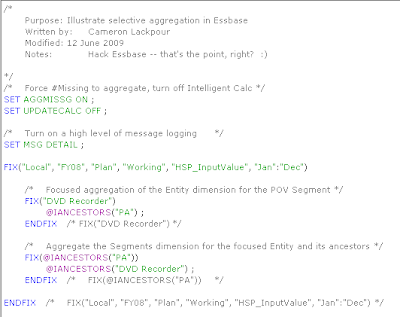

The results of the above versus that AGG/CALC DIM is exactly the same, only the focused aggregation does it in less than a quarter of the time.

Correction
My good Hyperion buddy Joe Aultman pointed out an error, or at least a redundancy with the above code.

Basically, the @IANCESTORS within the FIX statement isn't needed as the members themselves don't need to be aggregated, just their ancestors.

The code as posted will result in the right value, but will be that fraction of a second slower as it is addressing two more blocks. We don't want that, right?

I don't know why I wrote it in this blog with the @IANCESTOR within the FIX as that isn't how I do it at my clients. Overthinking it, I guess.

I have inserted a snippet with the correct, @IANCESTOR-in-the-FIX-only approach below. This code also shows HBR local variables for the form's run time prompts.

Back to our regular programming

That’s it. Skeptical, are you? Can’t be that easy? The proof of the pudding is in the eating. Let’s trace the data by only changing Operating Revenue for January through March.
1) Here’s the form with the original data:

2) Let’s round the numbers up and send to Essbase:

3) Switching to Excel, the blue cells show the data that should be updated. This sheet is easy peasy, as it just shows aggregated dynamic Accounts.
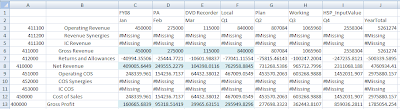
4) And here it is where we expect to see it aggregated one level up, by Entity and Segment.

5) And now let’s look at the when the focused aggregation HBR is run.

Notice that it doesn’t matter if we do or don't aggregate MA, NY, DVD Player, Portable DVD, and DVD/VCR combo. Only PA and DVD Recorders changed, so only their parents need be aggregated. In other words, only aggregate parents whose children's values change, and leave the rest be.
6) Here it is rolled up by Entity.

7) And rolled up by Segment.

The Payoff
What does this mean from a performance perspective (faster=better)?

Looking at the Plansamp.log file, we can see that plain old AGG took almost 7 seconds:

Where the focused aggregation didn’t even make it to 2.5 seconds.

In the Real World

Just yesterday I benchmarked a real Planning HBR with the AGG versus focused aggregation approach. How about 180 seconds versus 24 seconds? Now we’re talking 1/8 of the time. This is powerful medicine.

YMMV; these are the results I got for my client’s Essbase database. Every database is different, so my performance improvement won't necessarily map to your application. Regardless, the above technique can make “big” Planning applications fast and give you the run on save performance your users demand.

See, I love Hyperion Business Rules.

See you next time.

Sunday, June 14, 2009

The Fare Hike Is Unfair

Once again, politicians who pay lip-service to improving transportation are trying to put your money where their mouths are: Governor Rell is proposing a 10% fare increase for Metro-North and a 40% fare hike for bus riders.

Her arguments for raising fares are specious:

1) New York Raised Its Fares, So We Should Also: NY State is raising its fares to pay debt service on $12 billion in bonds raised to invest in subways and trains. It had threatened 23% fare hikes and draconian service cuts (even in Connecticut), so the compromise 10% fare hike (June 17th) seems like a bargain. The MTA dug itself into a financial hole and wants riders to dig it back out. And Connecticut should mirror such bad public policy?

2) The Special Transportation Fund Is Running Out Of Money: True, but this is because lawmakers stupidly lowered gasoline taxes a decade ago. Those fuel taxes help subsidize rail fares and I predicted then that their loss would lead to higher fares. The way to replenish the Fund is to raise gas taxes. For just a one cent per gallon tax increase the state would gain enough revenue to halt the planned bus fare hike.

Sorry, Governor. Your rationale for taxing commuters just doesn’t make sense. Consider the consequences of these proposed fare hikes:

1) Increased Road Traffic:
Higher fares just encourage people to get back in their cars and drive on already congested highways. Isn’t this what we were trying to prevent?

2) Exploiting The Poor: The folks who take the bus don’t have cars. They have no other option than to travel by bus to school, to jobs and shopping. For them, a 40% fare increase means less money for food and medicine.

3) Discouraging Business: What employer will want to open a new business in a state where potential employees can’t afford to get to their jobs? A fare hike on trains and buses is anti-business and anti-growth.

4) Reduced Ridership / Even Higher Fares: Making the trains and buses more expensive will discourage ridership just as the new M8 cars start to arrive. Fixed operating costs won’t change, but reduced income from reduced ridership will just lead to calls for more fare hikes, a never-ending downward spiral.

5) Fare Increases Are Already Planned 2010 – 2016: Rail commuters already know they’ll be paying a 1.25% fare hike January 1st in 2010… and additional 1% fare hikes each New Years Day until 2016. This money is to help pay for the new M8 cars which are already behind schedule due to design problems and testing issues.

Hopefully, Governor Rell is just bluffing. Maybe she’s using the fare hike threat to jolt the legislature into action. But what politician would be so foolhardy as to support these fare increases, then look voters in the eye and ask for re-election?
While the downstate delegation may “get it” when it comes to supporting mass transit, the pols upstate clearly don’t have a clue.

Remember, it was just two years ago that Senate President Don Williams from “the quiet corner” of rural Connecticut was proposing free fares for senior citizens on all trains and buses. What a concept: a free ride on Metro-North for seniors while working stiffs pay $300 a month. Fortunately, that idea went nowhere.

So keep an eye on the legislature in the coming weeks. The process of creating a balanced budget won’t be easy or pretty to watch.

But if you want a say in stopping a hike on bus or train fares, contact your state lawmakers now. Only if bus and rail riders speak up can the Governor’s plan be defeated.

Sunday, May 31, 2009

Unfinish Work at CDOT

Here’s a quick update on some issues I’ve written about recently, but first some breaking news!

FARE INCREASE: In desperation to find a way to balance our state’s budget, Governor Rell is playing her “trump card”, calling for a 10% fare hike on Metro-North. Her reasoning? “New York raised their fares, so should we”.

But remember… the NY fare hike came because of MTA’s budget crisis. Having spent billions for decades on rail improvements, they couldn’t get up-staters to pay the bills, so they threatened service cuts and 30% fare hikes. Bottom line: a 10% fare boost in NY looks cheap.

That is not our situation in Connecticut, where there wasn’t spending as train service deteriorated, ridership rose and fares remained steady. Yes, the long promised new M8 cars are coming, but will be paid for (in part) by long-planned annual fare hikes that begin January 1, 2010 and continue to rise 1% per year for the seven years.

Governor Rell’s call for a 10% fare hike now is a break of her promise of “no new taxes”. A fare hike now is a tax on commuters and another disincentive to live or work in Connecticut.

If the legislature approves the fare increase there will be public hearings, but they’ll be a meaningless, moot exercise. If you oppose a fare hike, call your state lawmakers now!

PARKING TASK FORCE: In January Governor Rell trumpeted a fresh new look at the issue of rail station parking, calling on CDOT to create a Parking Task Force (on which I was invited to serve). Five months later, CDOT’s Task Force has yet to meet, not even once. Blame it on foot-dragging by the regional planning agencies or lack of focus by CDOT, but nothing has been done to add parking at the stations even as the new M8 cars are scheduled to arrive, increasing capacity on our trains.

THE BRAIN DRAIN: In a call to save money, the state recently offered senior staffers at agencies like CDOT a sweet retirement deal. And many took it. So this week a former Deputy Commissioner and the Rail Bureau Chief have left the agency, taking nice pensions and a combined 50 years experience with them. (At least one is going to a consulting job where he’ll work on CDOT projects at better pay). A state hiring freeze means these men can’t be replaced. That means more work at CDOT for fewer, less experienced staffers.


RIDERSHIP IS DOWN:
You can finally get a seat at rush hour on Metro-North, as the railroad has seen ridership plummet 4% month over month thanks to the economic carnage and resulting jobs losses in NYC. Fewer riders means more pressure for fare increases.


WATERBURY WOES:
However nasty your commute may seem, some have it worse… the riders of the Waterbury branch. At a recent CT Rail Commuter Council meeting in Naugatuck a mob of 50 angry passengers gave CDOT and Metro-North representatives an earful.

They have no stations, just bus shelters. Despite a 34% increase in ridership last year, they have only half as many trains as the Danbury branch. Cars are often filthy… in one case spewed with vomit that wasn’t cleaned up from the night before.
Automobiles parked in Waterbury are frequent targets of vandalism with local cops and the MTA Police blaming each other for lack of enforcement.

Adding insult to injury, all rail service is being halted for a month this summer to rebuild the tracks and ties (and an aging bridge) on the entire branch. That will mean busing… always a treat.

Monday, May 18, 2009

Gridlock in Hartford

I’ve written many times before of failed efforts to fix our transportation mess… how the only money being spent is not on solutions but on endless studies and consultant reports whose recommendations go unheeded.

Now we’re about to see another example as the Transportation Strategy Board is expected to do nothing with suggestions for electronic-tolling of our congested roads to mitigate congestion and raise badly need funds.

After commissioning a $1 million, 500-page study of the issue, the TSB is expected to say that the idea of “value pricing” our interstates needs, you guessed it, yet more study!

I could tell the fix was in when, even before the consultants delivered their million dollar baby, Governor Rell said she was against tolling.

And don’t expect any leadership on this issue from lawmakers, unable to write a budget let alone show the courage to face a controversial issue like tolls.

As one transportation expert says, the eight year old Transportation Strategy Board has turned into a “debating club”, endlessly talking but doing nothing. Their meetings get little attention and most members attend only sporadically. How would you like try making an 8 am weekday meeting in Hartford, so scheduled that even CT-N can’t cover it.

With a decimated corps of Capitol newspaper reporters, who’s to cover such important discussions? And local media coverage to date has been either shallow or factually inaccurate.

The idea of bringing back tolls has been discussed for almost a decade. Yet every newspaper report about their elimination in 1983 always mentions the firey truck crash at the Stratford toll barrier that killed seven, as if toll barriers are just waiting to get hit.

Current tolling technology eliminates toll booths and their delays, but the mis-reporting continues. So much for what passes for journalism these days. Stories about “killer chimps” make the front page for days on end, while the real news goes unreported.

When the TSB received its $1 million consultant report, outlining nine different tolling options, the board scheduled public hearings across the state… except in Fairfield County. Little was done to explain what the consultants suggested, despite pleas for informational meetings.

So when 50 concerned citizens turned out last week in Norwalk for a last-minute public hearing, their opinions were mostly based on inaccurate media coverage. Few had read or even knew about the 500-page report, summarized at the hearing in a one-page handout.

It’s almost as if the TSB wanted the plan to die.

I’m all for a good debate, but if you don’t educate the public, should their opinions be taken seriously?

One after another, people called tolls a hidden “tax”. They were so cynical that they didn’t believe tolls would do anything to improve traffic (they would). Some called for higher tolls on out-of-staters (illegal). Two who spoke noted the connection between traffic and affordable housing. And one suggested investing in more cars for Metro-North, paid for by employers, their exteriors wrapped in ads for the companies.

Resulting media coverage ignored those, like me, who spoke in favor of tolling. The headlines screamed “Commuters Speak Out Against Tolls” when they should have read “TSB Gets Uninformed Opinions on Unexplained Million Dollar Study”, but I guess that wouldn’t sell newspapers like stories of killer chimps.

Our state is in gridlock, not just on our roads but in our government. Nobody has the vision or the courage to do anything to change our situation, preferring to hide behind endless studies and consultant reports which then get ignored.

Debating the problem for a decade has done nothing. And there’s no sign that the TSB, the Governor or legislature will ever do anything about transportation except what they’re done so far… talk.

Sunday, May 3, 2009

Views From The Train: "The Empire Builder"

This week, less “talking” and more observing as I share some “views from the train” on my recent ride from Seattle to Milwaukee on Amtrak’s “Empire Builder”.

Sure, it’s two days and nights, but I’m booked in a deluxe bedroom and am anxious to see the upper-tier of states that, to me, have always just been “fly over country”.

Puget Sound: Minutes after leaving Seattle, we run right alongside the beach. I see families walking their dogs, fishing boats brimming with their catch.

Into the Cascade Mountains and Stevens Pass, 4000 feet up, through the longest (7.9 miles) rail tunnel in the US. Still plenty of snow up here, but nothing like what’s to come.

Leavenworth Washington: 15% of the nation’s apples are grown in this one valley and in late April it is awash in blossoms. As far as the eye can see, neat rows of apple trees are festooned with delicate white flowers in the fading sunlight. Oh to be a honey bee!

Two Tylenol PM’s help me sleep. My bedroom is comfy but not for the claustrophobic. The only time I awake is when we’re not moving, stopped in Spokane where the other half of our train, originating from Portland OR, joins us.

The next morning we awake to four feet of snow in Whitefish Montana. After breakfast in the diner, it’s time to explore our eight car train. The sleepless from Seattle are still sprawled across coach seats. As we travel thru spectacular snow-capped peaks, one passenger sits watching a movie on his laptop, oblivious to the scenery.

A retired railroad guy regales me with stories of his days running steam locomotives, while a couple from Fargo ND tries to persuade me that they don’t really have accents like in that movie. Oh yah, eh?

No signal on my Blackberry, but a local paper is brought on board: “The Daily Inter Lake – Serving The Flathead Since 1869”. On the front page, news of yesterday’s amazing spring snowfall is still all too present out the window. On page two, a reminder that Friday is the deadline to apply for hunting permits to take moose and mountain goats.

I venture downstairs for a hot shower as we careen along welded track at 65 miles an hour. Try that on JetBlue!

My radio scanner crackles with automated “hot box” detectors reading off the number of axles scanned followed by a reassuring “no defects” and “temperature 25 degrees”.

Cutbank Montana: population 3171, 25 miles from Canada and a million miles from anywhere. This is why they call it “Big Sky Country”. We’ve gone from the Rockies to the prairies, the snow covered fields merging with the white clouds on the distant horizon. There’s no “here” here.

This is Indian territory, and what’s left of the reservations look like Appalachia without the pretty mountains. Trailers, abandoned trucks, trash strewn about and miles of nothingness. Hardly majestic. Mostly depressing.

In coach there are many Indians, moving across their country. This train isn’t just a land cruise for retirees but a vital transportation link for dozens of small towns long abandoned by even Greyhound.

Montana merges into North Dakota and we look forward to a servicing stop in the “big city” of Minot, population 37,745. While walking the length of the train I discover we’ve been hauling a private rail car, complete with observation platform. Crowds of curious passengers and towns-folk (not to mention a few “foamers”) snap pictures, but the sole inhabitant of the Soo Line business car doesn’t invite us in.

In the diner, a retired Schlitz worker heading to a reunion in Milwaukee (made famous by his suds!) complains he can’t get a beer with dinner. An ex-Canadian Navy guy regales me with stories of his last long-distance train ride… in 1955, on the way to basic training. Chris, our sleeping car attendant, chats with his 20-something buddies by cell phone planning his summer music festival itinerary. One perk of his job… free Amtrak travel.

A restless night and a long detour around still-flooded Fargo ND, we awake in St Paul MN. From here we follow the Mississippi, La Crosse and Wisconsin rivers to Milwaukee where I get off to catch a flight home.

This isn’t Amtrak’s most scenic trans-continental run, but it’s one of the most vital… connecting people to their work, their relatives and the rest of their country. I have a better understanding of the nation’s heartland thanks to this run.

But I’m also glad to get home.

NOTE: For a multimedia view of why folks loving riding the rails, see this link from The New York Times.

Popular Posts