Showing posts with label OpenWorld. Show all posts

Tuesday, December 1, 2015

The Compleat Idiot’s Guide to PBCS, No. 1 – Documentation

No, this isn’t my series on Volkswagens

Although I do come from a family members who were smart/crazy enough to own a 1953 VW Zwitter Bug (so long ago the color is unknown, but probably white), a 1966 and 1971 Squareback (a combination of awesome and rust and occasional fires but overall awesome), and a 1976 Dasher Wagon (apparently such a lemon no one actually seems to have a video of it and this snap doesn’t share the horrific 70s brown color), I am without doubt a Compleat Idiot when it comes to Planning Budgeting and Cloud Service.

My goal with this series, so long as I have access to a PBCS instance, is to bring the non-PBCS customer and consultant along with me as I explore the tool and compare and contrast it to on-premises Planning.

Fwiw, I don’t think on-premises is going away any time soon, but PBCS is the vanguard of Planning functionality.  See it in PBCS and soon (hopefully) it’ll be there on-premises.  Looking at PBCS is a time machine into the future for us in on-premises land.

Reading all about it

The first and most obvious place, even for we geeks who think we know Planning is the documentation.  Yeah, yeah, I know, real geeks don’t read the docs but I’ve learnt to do it because I’ve been burnt too many times, cf this post on security within dimensions.  Also, without the Tech Ref I think my career would be over.  There are gems in the docs if you know where to look.

That’s probably my greatest complaint about EPM documentation.  How do I know where to look?  Why does the documentation (I’m looking at you, DBAG.) look like it’s a refugee from 1994?  As an example, the DBAG really hasn’t changed much since I first laid eyes on it last century and is still strangely BSO-oriented.  I like BSO.  In fact I love BSO.  Within Planning, it’s where I earn my living.  But where’s the detail on ASO?  There is one chapter on ASO in the DBAG.  One.  Hybrid?  514 words. Rant over.  

Planning isn’t much better.  Except it is in PBCS.   Oracle have taken a very different and welcome approach to documentation.  The key differences are organization and the tutorial orientation.

Task versus subject

From an organizational perspective, instead of a monolithic administrator’s guide, the documentation is broken down by task:  building applications, data integration, different ways to plan (task lists, browser forms, Smart View, predictive planning), creating applications, etc.  

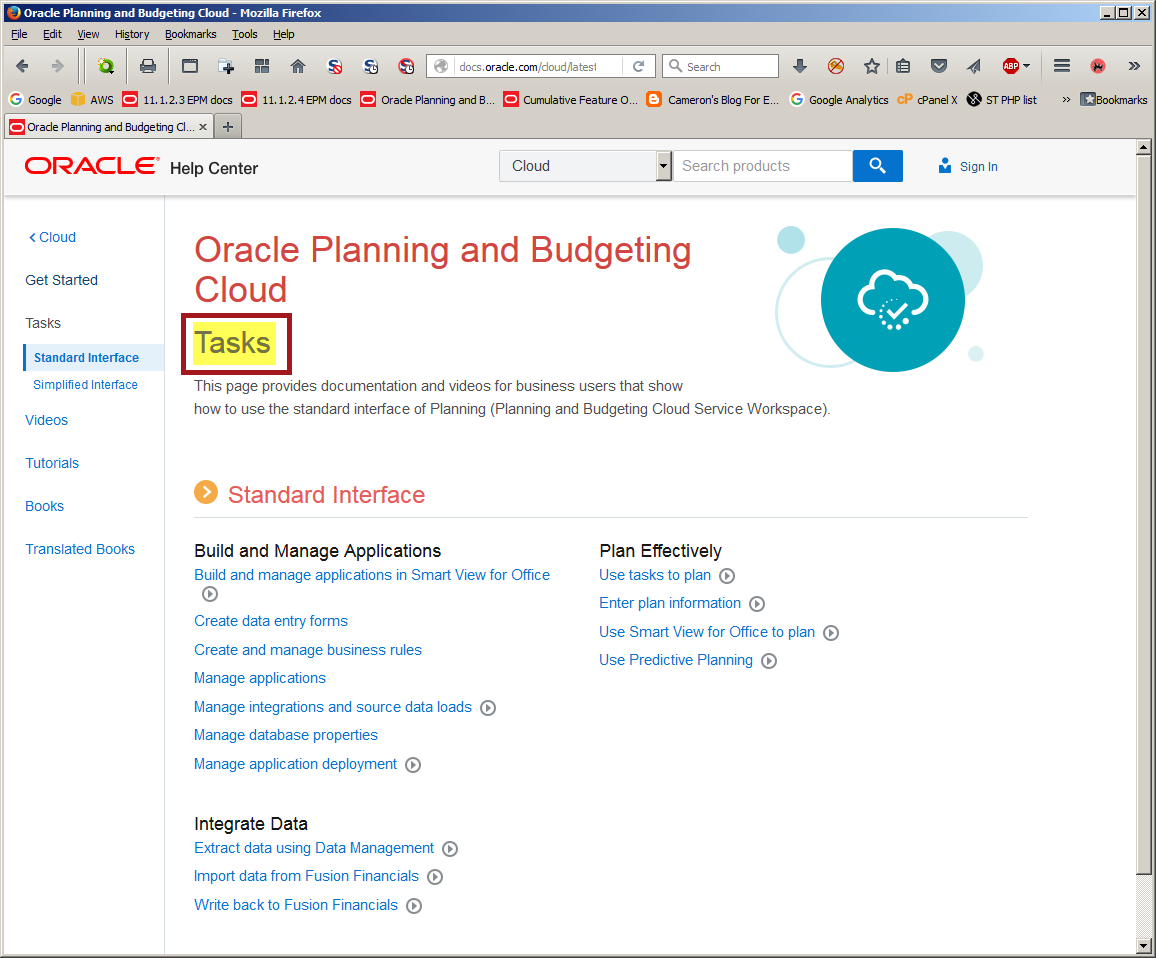
Here’s the PBCS standard interface landing page.  Note the word “Tasks” in great big type.
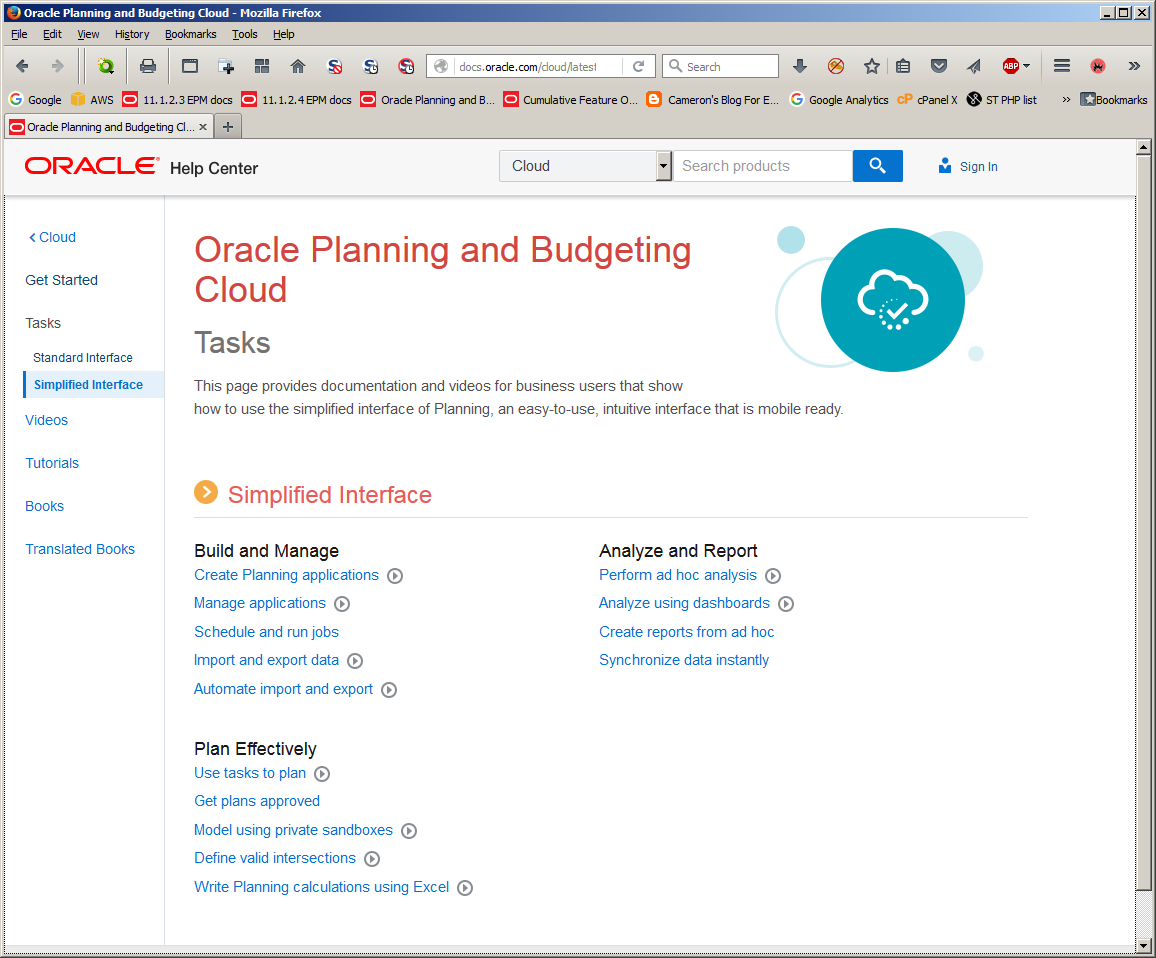
And the simplified interface.  Again, Tasks are the focus.
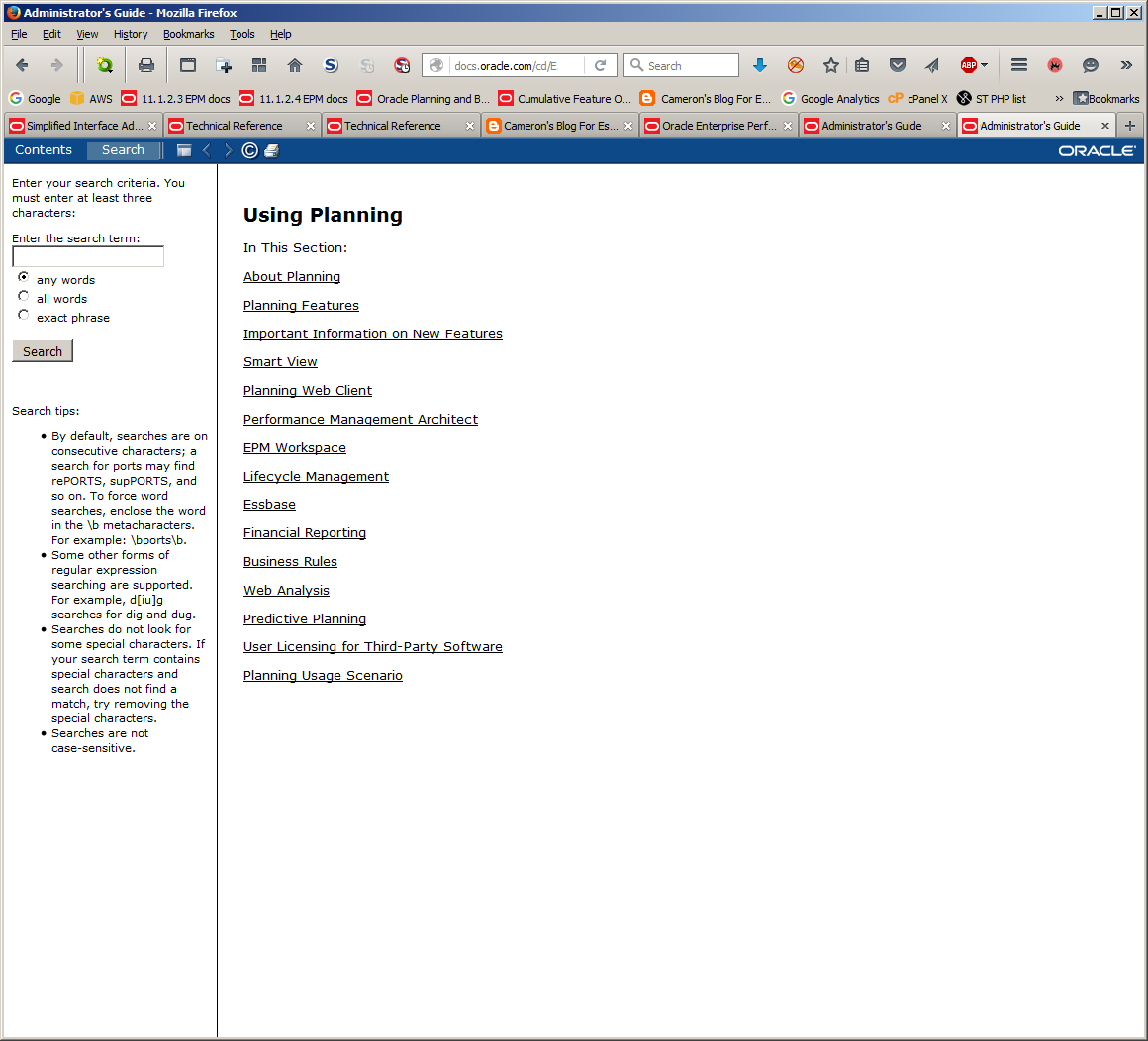
Contrast that with on-premises’ standard interface landing page:
And the simplified:
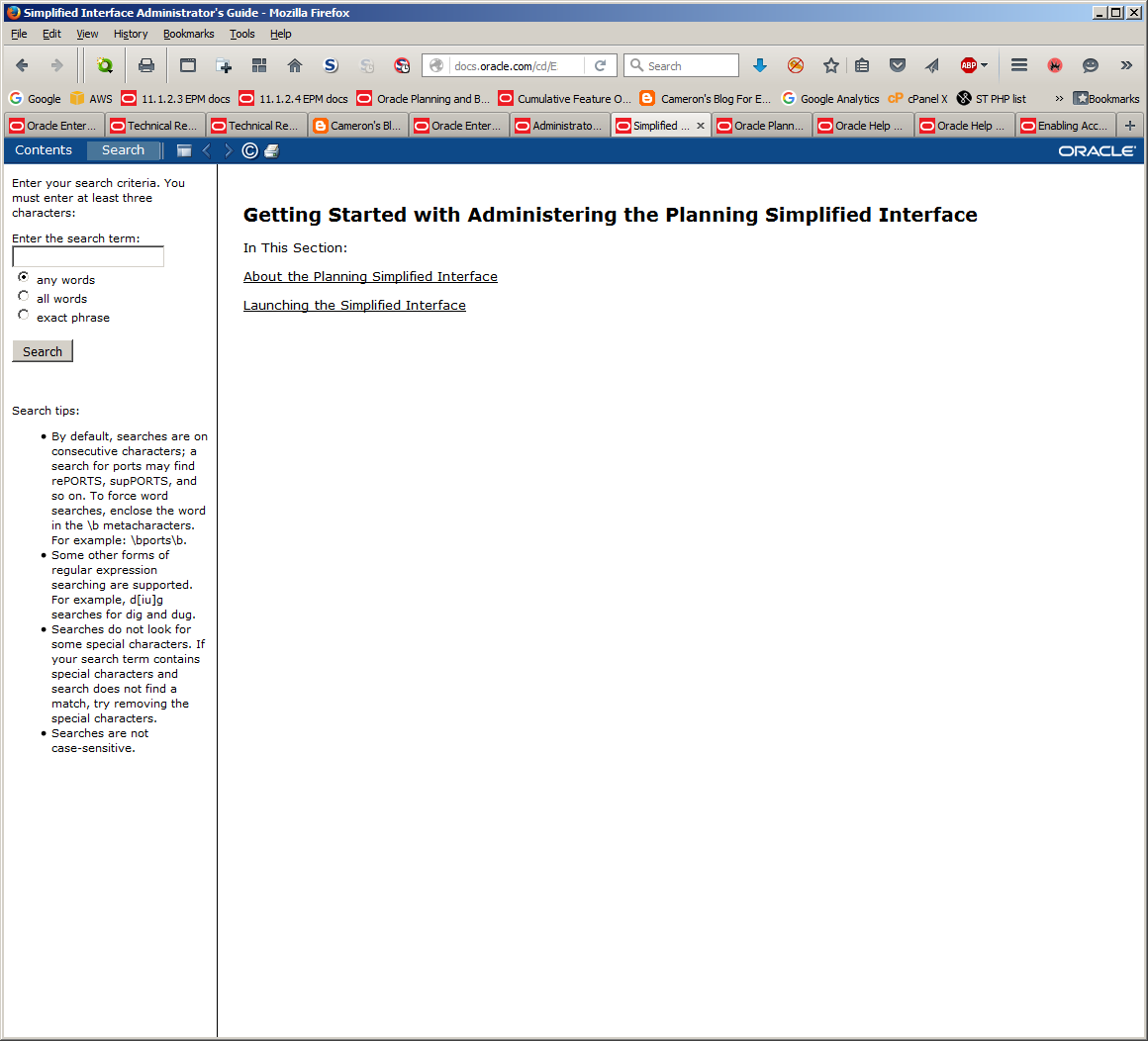
NB – I checked with Oracle and the below is NOT correct.  One day, maybe.  Unless I can’t read (eh, you see how I write so likely my reading is just as bad), there’s nothing that says it’s PBCS only but Oracle have stated that Sandboxing and Valid Intersections are PBCS only at this time.  Bummer.


Not terribly informative.  If you don’t click on contents, you’ll miss this little bombshell:
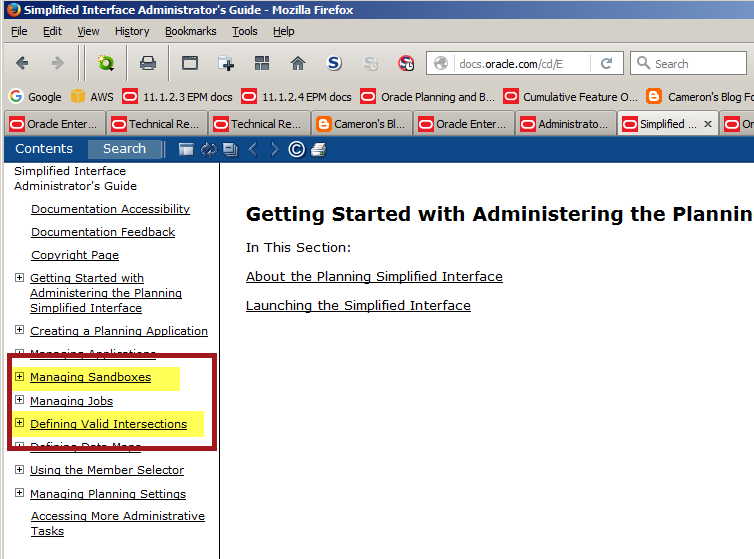
You are looking at sandboxing in on-premises Planning!  Talk about finding stuff out by reading the docs.  Who knew that was there?
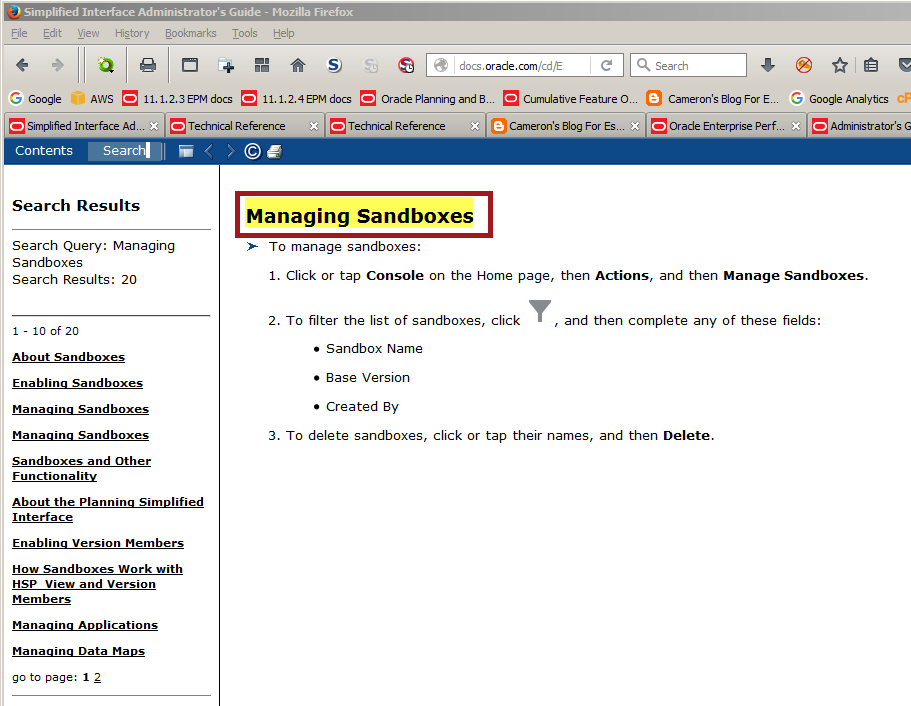
That was hard, too hard.  And I just found it through sheer luck.   

Mistake or no mistake, contrast that with PBCS’ simplified interface docs:
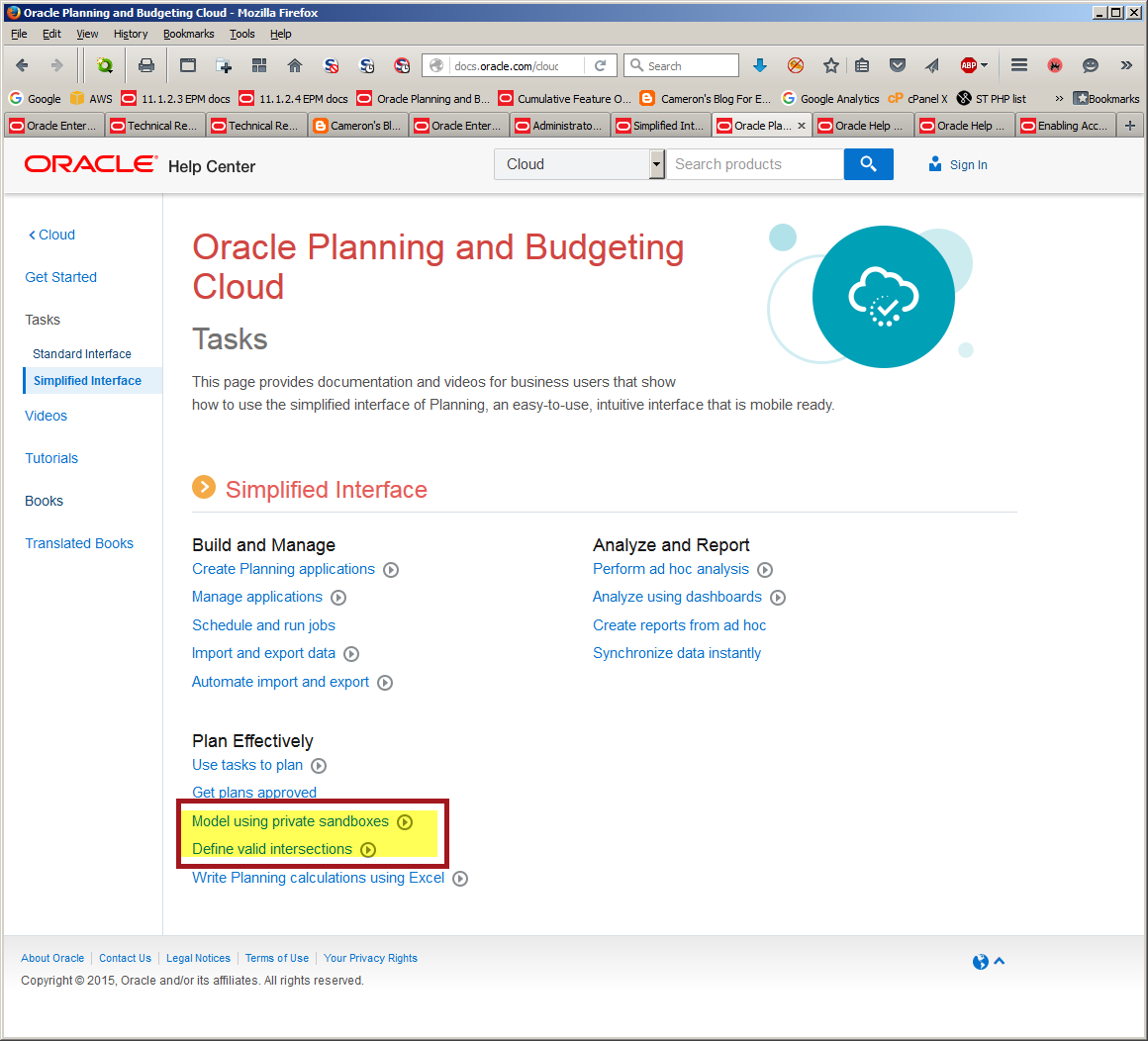
A bit easier to find, isn’t it?

Video killed the radio star

Sometimes a picture is worth a thousand words.  Sometimes a video is worth a thousand pictures.  So that means that a video is worth a million words?  Maybe, because there really is nothing like actually seeing something being done.  And PBCS has it in spades.
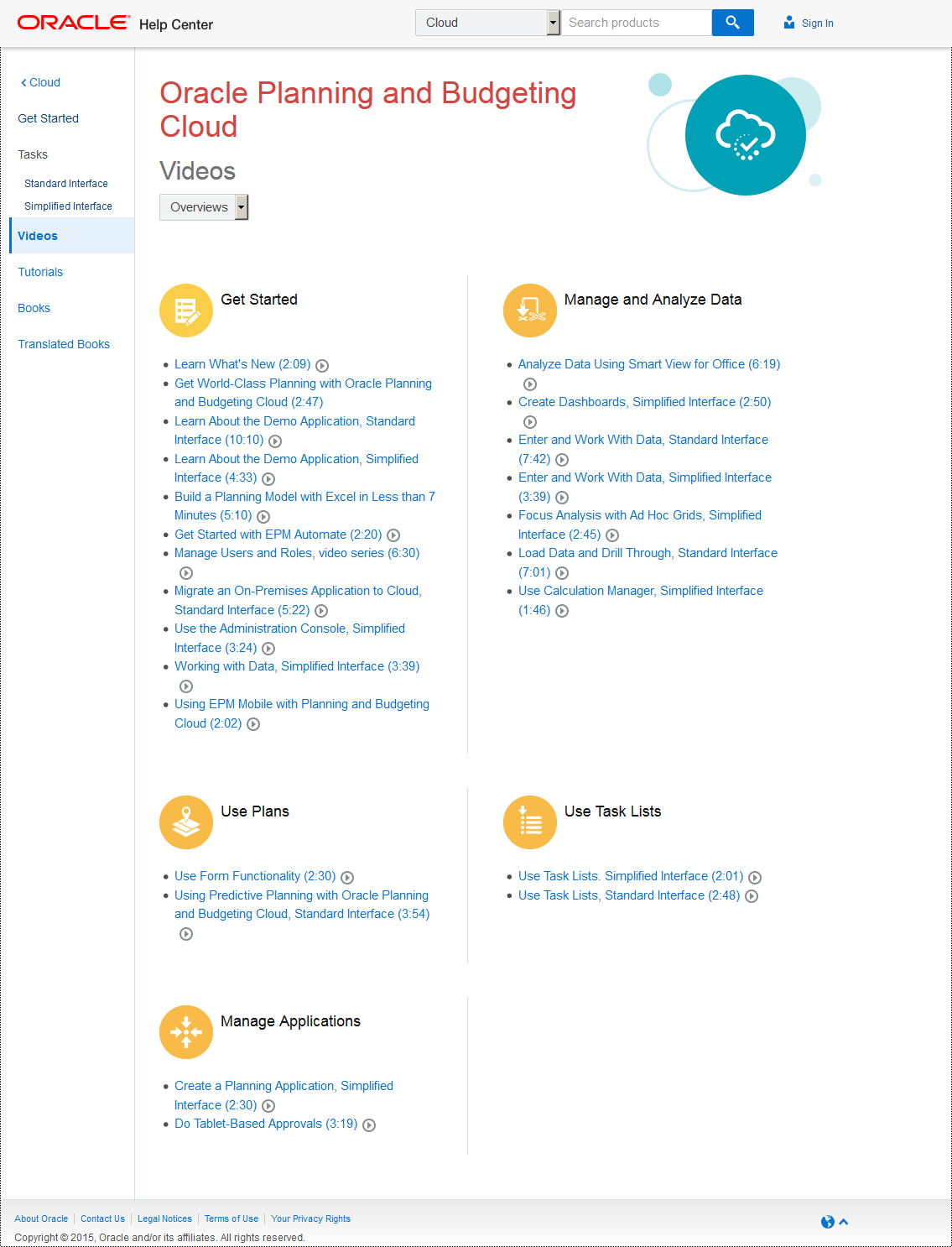
You can watch videos within the docs:
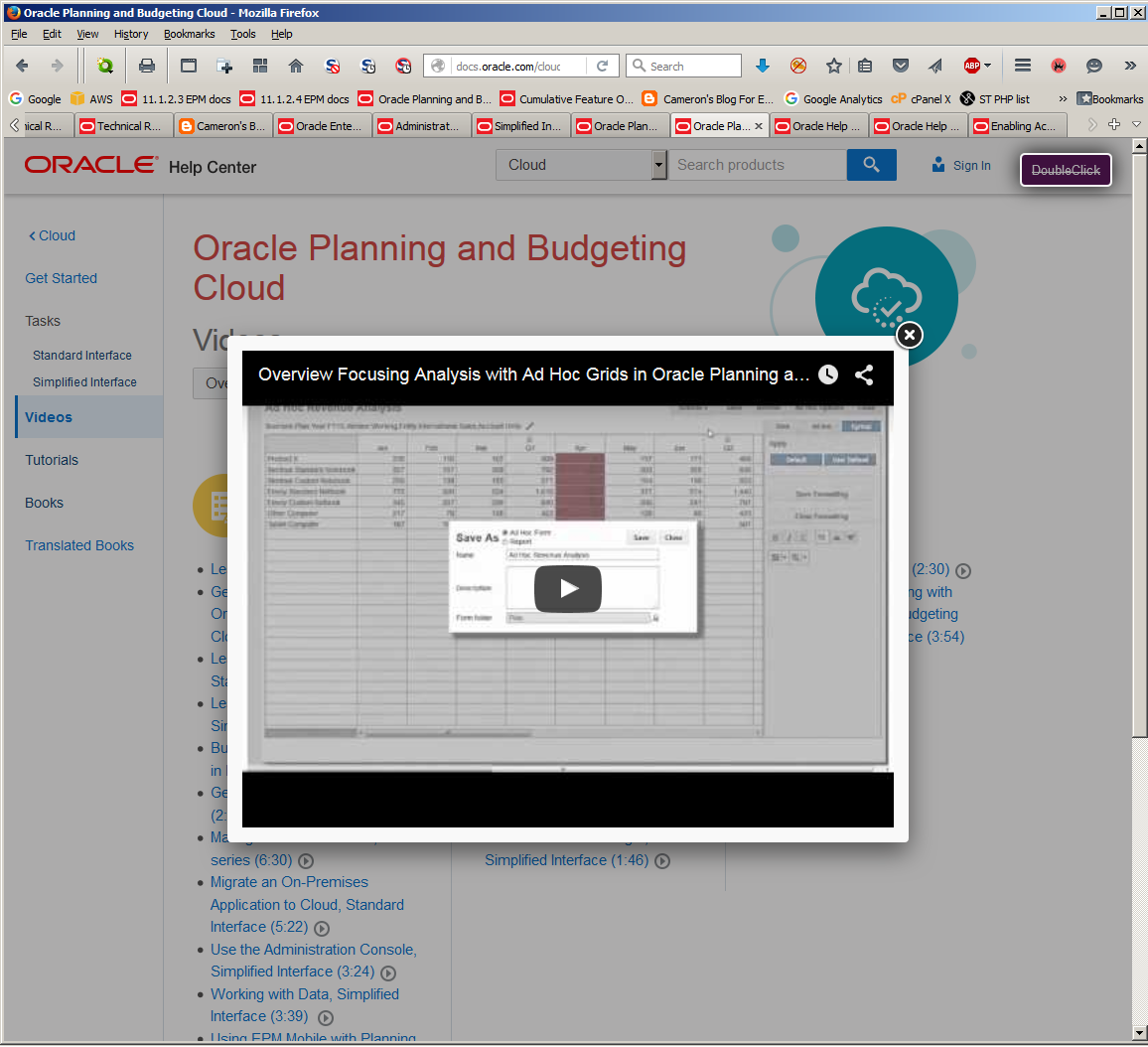
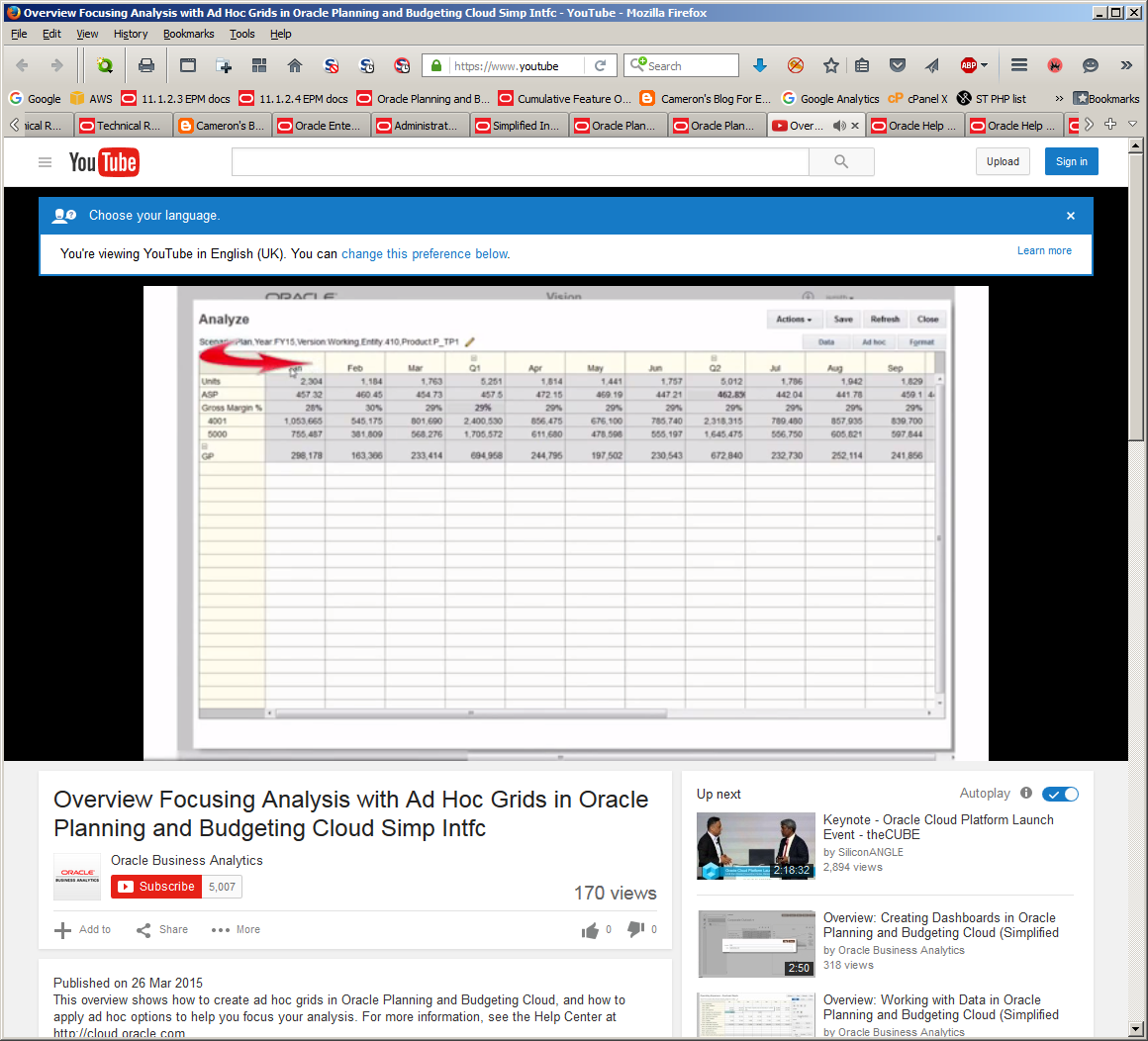
Or just directly in YouTube.  There’s an entire library of videos there but I’d avoid the temptation of looking at cat videos if you value your job.
Teach me, teach me teacher

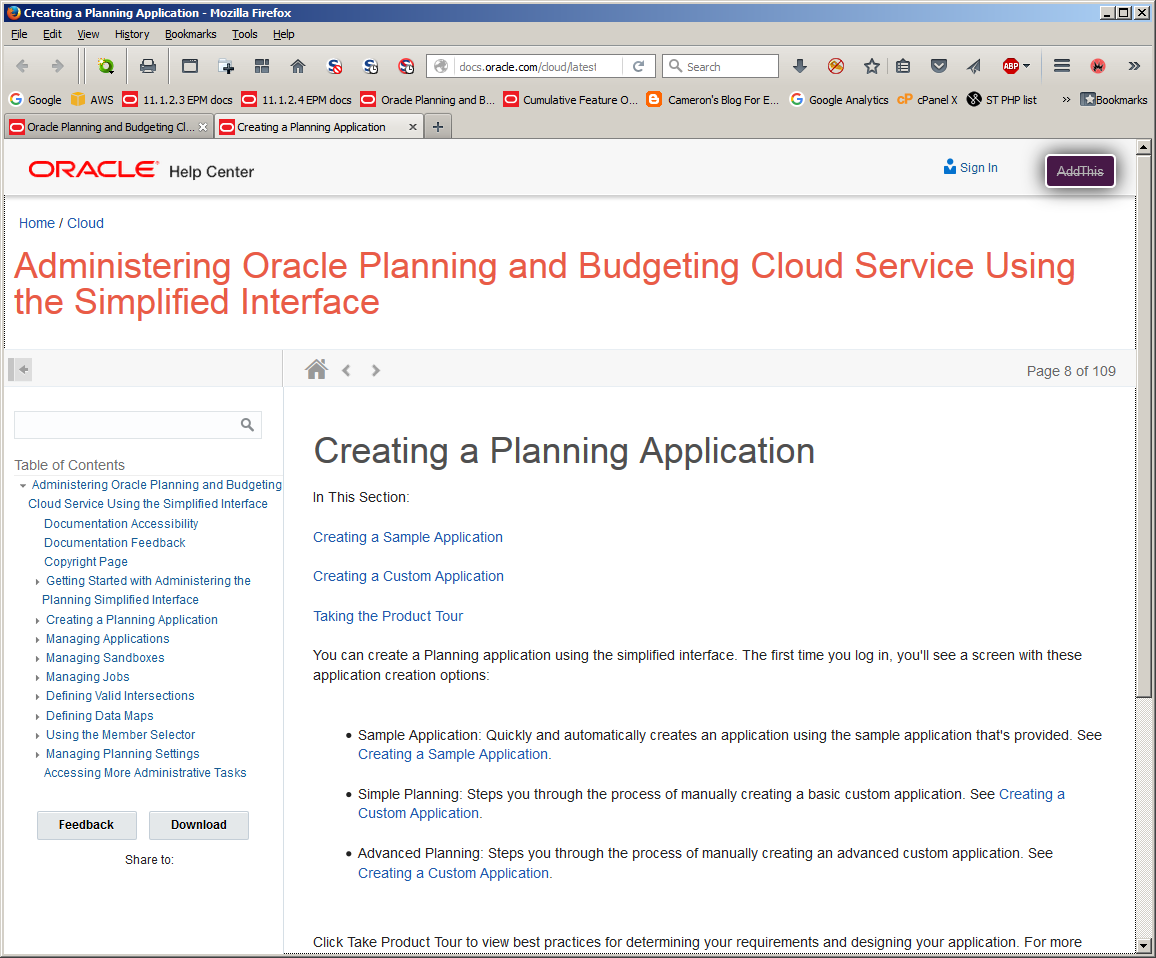
The other difference is the heavy tutorial orientation.  Want to create a Planning app?  Here it is, step by step:

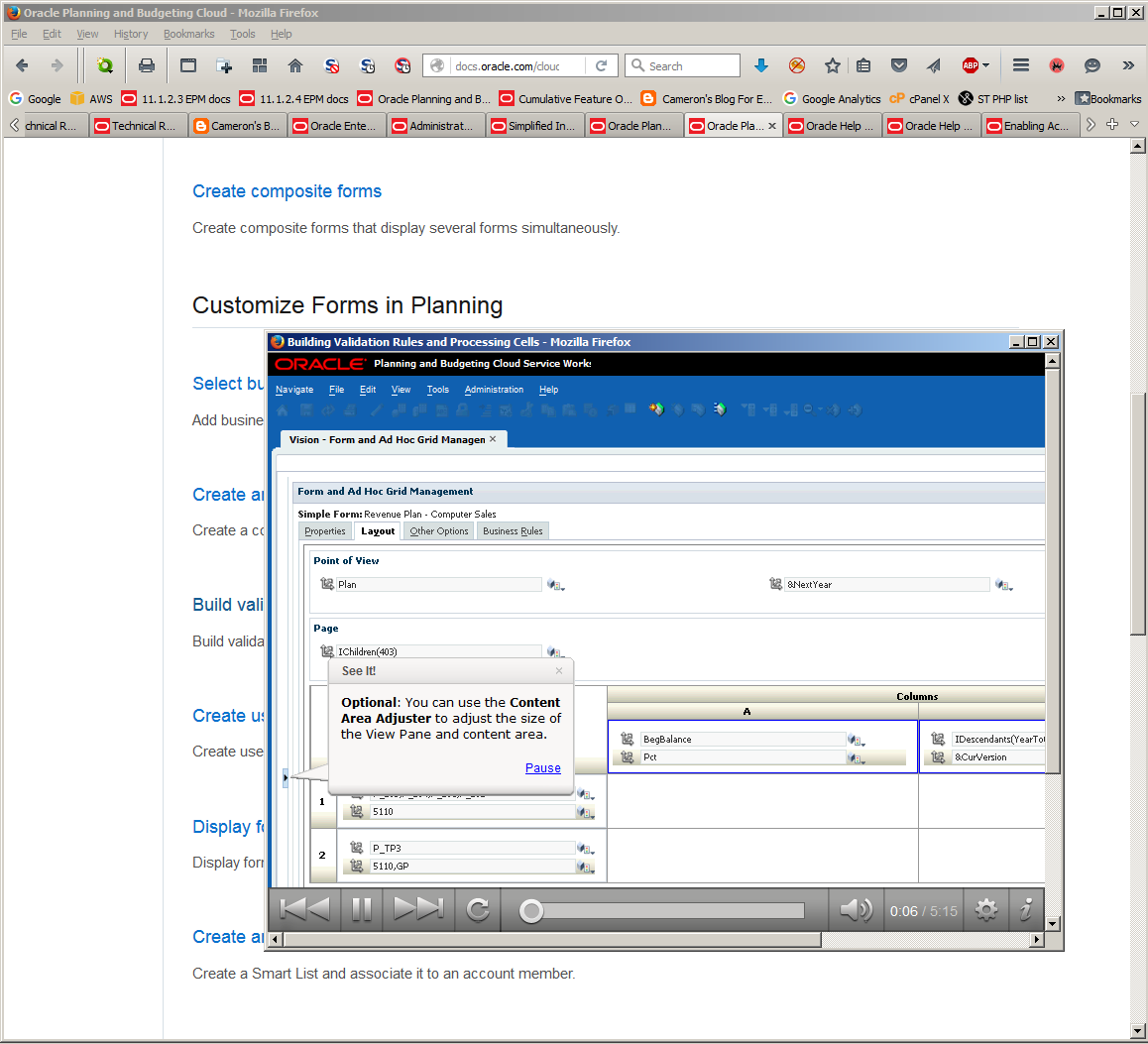
Want to see how to do something step by step by step in a task-oriented manner?  It’s there.
So what does this mean for on-premises?  

The PBCS documentation is awesome.  Good grief.  All of it:  the task orientation, the ease of finding information, the videos, the tutorials, everything really is amazingly good.  Did I mention it is awesome?  It is.

And it isn’t there for on-premises Planning.  

Having said that, there is nothing, absolutely nothing stopping you from jumping over to the PBCS documentation site and having a gander at the tasks.  Creating a form?  It’s there.  Task lists?  It’s there.  What’s stopping you from going there and stealing getting ideas for your custom training?  Or just learning how to do something?  Most but not all of the functionality is the same.

There are differences.
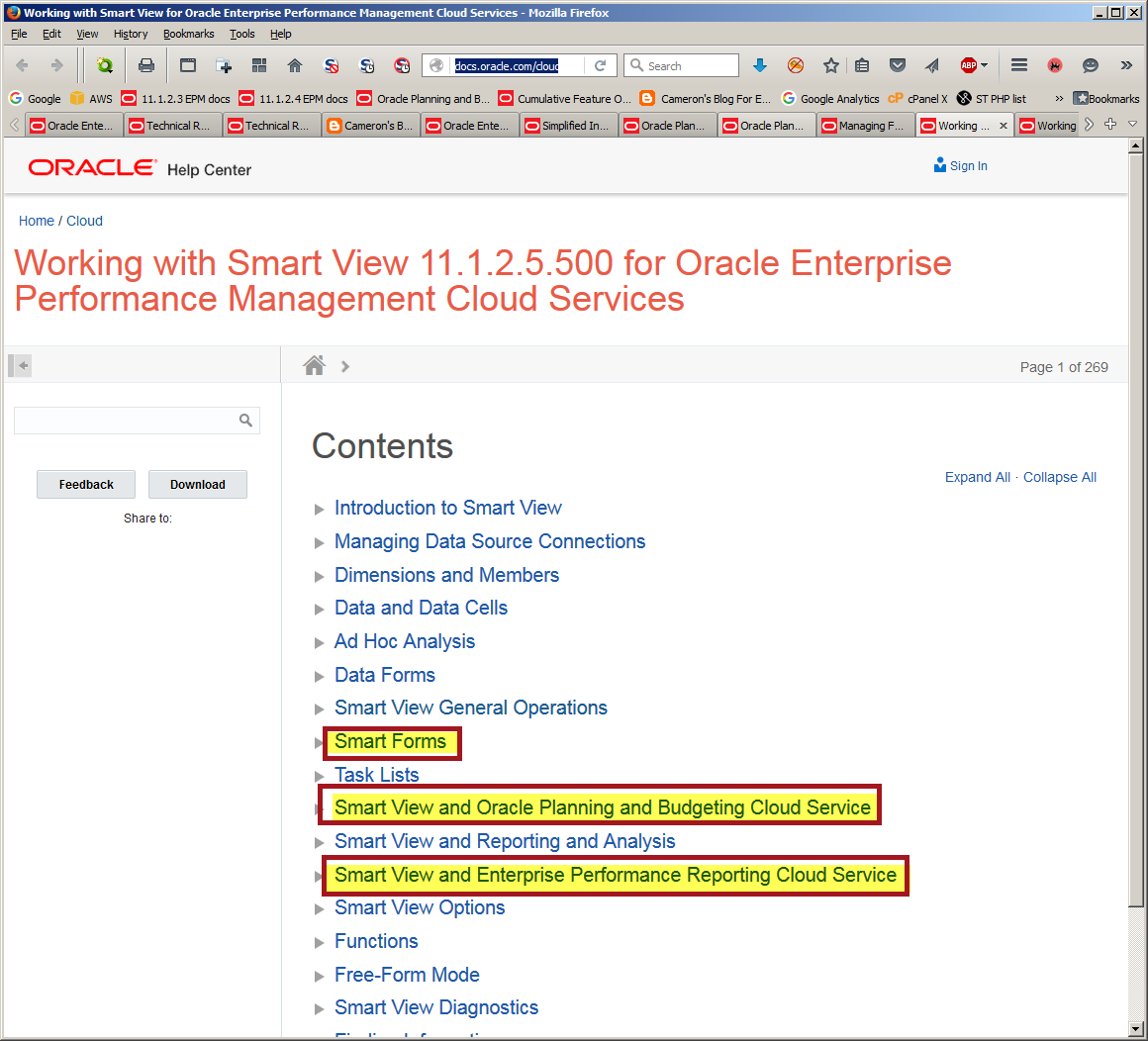
But they’re easy to see.  And avoid.

Where will Oracle go with this?

I don’t work for Oracle, a fact that the Oracle Corporation is undoubtedly profoundly grateful for, but I can take a couple of guesses as to why the documentation differs so and what will maybe happen in future.

The Cloud is a huge focus and emphasis at Oracle.  OOW was awash in Cloud and in our world, it was omnipresent with Essbase Cloud Service (EssCS) and just about everything else.  Where there’s an organizational push, there’s funding, and where there’s funding there’s product.  PBCS’ documentation Is part of that product.

What about on-premises?  A fantastic question because the current version doesn’t seem to have changed since approximately the Year Dot other than getting updated with new functionality.  My hope would be that Oracle copies the PBCS documentation (it is after all largely the same) and makes an on-premises version of it.  Or perhaps a more desirable approach is to take the PBCS documentation and somehow note that Smart Forms or whatever are PBCS only.  That latter approach would mean that as on-premises Planning picks up PBCS functionality that does-not-work-yet flag is removed.  Should the existing on-premises documentation remain as an alternate tool?  In an ideal world sure, but that would mean Oracle have to support two documentation lines.

The great news about this all is that PBCS has given the EPM team a chance to rethink and rewrite their documentation.  It’s really good.  And because so much of it is applicable to both on-premises, those of us not in the PBCS world can use much of it.  That is exactly what I’m going to do for both myself (I told you I actually RTM) and my customers.

But all of this post is one geek’s opinion.  What do you think?  What would you like to see?  Send me your thoughts, whether by email (the unlucky ones know it) or comments to this blog (you can hide behind anonymity if you wish) and I’ll pass it on to the Oracle documentation team.  They really do want to hear your opinion and it does drive their decision making.  

Be seeing you.

Monday, November 23, 2015

The end of OOW 2015, the Cloud, and us

A day late and a dollar short

Apologies for the tardiness of this, the incredible tardiness, really, but I have been beyond swamped by work.  I try not to bring my Cameron-actually-gets-paid-for-this-work life into this blog (although I am in fact not independently wealthy and must earn my crust) and this is `certainly not a marketing moment because I couldn’t market death during the Black Plague, but more of an excuse that this was an assessment to end all assessments (strategic, staffing, infrastructure – okay, that bit I merely stole incorporated someone else’s work – design, implementation, administration, etc., etc., etc.) and I had to put in an insane number of hours.  It wasn’t a chapter in a book (please, give me a few years to emotionally/financially/professionally recover from the latest) bit it was damn close.

Also, that was perhaps the most epic run-on sentence I’ve written since 7th grade.  Mrs. Baker, if you’re reading this, I know you’re proud of me.  Or perhaps mortified.

So with that hopefully accepted excuse and call out of my atrocious grammar, and since I’ve completely and totally missed the window for live blogging OOW 2015 (to put it mildly) I’m going to focus, as many others have done, with my take on the fairly momentous announcements this year.
One note before I dive into the meat of this -- for those of you who follow me on Twitter, I did live Tweet the conference.  It wasn’t quite like being there but it was as close as I could make it in real time.  Check me out at @CameronLackpour and yeah, this makes me a completely sad social media geek.  I promise not to tweet about hamburgers or inspirational sayings or how awesome I am – there is a surprisingly large amount of that, even in our space, and it’s drivel.  Of course, as what I post is also sometimes complete and utter crap, I suppose I am guilty of the same sin.  I also throw in an occasional retweet of @King Henry VIII, @sadserver, and @honest_update but otherwise I am all work, all the time which makes Cameron a dull boy.  Have truer words ever been written?

Back to the subject at hand, please don’t misunderstand what I am about to write as I find OpenWorld (OOW15) to be:  evincing, enervating, educational, and exhausting.  The product briefings and explanations of Oracle’s general product direction are always valuable.  But there has been a certain lack of excitement in the EPM space during the few years I’ve been attending OOW.  That sure wasn’t the case this year.

And finally, the point of this post

I’m going to try to look at what’s coming from the Cloud and what it means for us from a can-I-keep-my-job perspective for Planning and Essbase geeks; I’m simply not qualified to comment on the other applications except in the most general of ways.

Moving on from the products, the person I expect to read and hopefully get value from this is a geek who is somewhat concerned about what these tools will do to his continued employment.  Is there anything to worry about or is it all peaches and cream.

I think it’s the latter, and with luck the below will make you agree.

Brave New World

It’s a brave new world, and one that a number of consultants (like hangs out with like) have complained about or more accurately voiced fears about what it means for their skillset.

Will it still be technical?  Take a look at my younger, smarter, taller brother from a completely different set of parents, i.e., Celvin Kattookaran.  He’s doing all kinds of technical stuff with the cloud.  My (and your) inner geek can rest easy.

What about infrastructure consultants?  They are in a bit of a pickle as so much of the cloud offerings are to get around the Horror That Is EPM Infrastructure.  I’m not sure what to say about this one other than if they can do infrastructure, they can do functional EPM with their collective eyes closed.  But yes, the glory days of that seem to be on their way out, although there will be plenty of on-premises customers for quite a while to come.

Will there still be design work?  How could there not?  Businesses still have to figure out how to go from where they are to where they want to go, and how that journey fits in with the EPM product line.  We do that all the time unless we’re in code monkey gigs.  

Planning and Budgeting Cloud Service

It’s here, it’s been around for over a year, and it’s wildly popular.  I don’t know the exact numbers, but I do know that it’s far outselling new instances of Planning.  I would imagine there are also a fair number of conversions from on-premises to PBCS.

Given that’s a released product, all I can say is go have a gander at the exhaustive documentation here

It’s largely the same application with some wizards (Sample – same concept as before, Simple – quick and dirty, and Advanced – what we likely are familiar with using on-premises).

Note that are none of the specialized applications such as Workforce, Capex, etc.  You get to roll your own just as in the days of yore.

I don’t see a diminution in any kind of skills that your typical functional consultant or administrator exercises on a regular basis.

PBCS Enterprise aka Enterprise PBCS

Those missing sort-of-prebuilt modules we know (and sort-of-love) in on-premises Planning.  They’re in EPBCS, and quite a bit more.

This one’s a bit harder to understand from a skills perspective both because the product isn’t out and the details, at least to non-Oracle employees aren’t totally clear.  

What is clear is:  pre-built content, wizards out the wazoo – alliteration is our friend – for all kinds of Plan Types.  Financials, Workforce, Capex, and Project planning are all part of the product.

Here are some further details and before anyone gets excited, here’s the standard Oracle Safe Harbor statement:

The following is intended to outline our general product direction. It is intended for information purposes only, and may not be incorporated into any contract. It is not a commitment to deliver any material, code, or functionality, and should not be relied upon in making purchasing decisions. The development, release, and timing of any features or functionality described for Oracle’s products remains at the sole discretion of Oracle.


Also, before anyone else gets excited (I’m looking at you, Oracle) everything I’m going to note is publicly available from the OOW portal.  I saw some of this before the conference, and yes, my lips were sealed.  But now?  This is available to all.  Who knows if any of it will come true, cf. the Safe Harbor, but one can hope.

EPBCS will have Financials (bread and butter of Planning), Workforce (ibid.), Projects (Project Financial Planning), and Capital (Capex).  Nothing new here, nothing that at first blush that should make us worry.  

But it gets better.  Financials will have prebuilt components for Financials (Gross Margin), Expense (Opex, taking into consideration Capex and Workforce), Balance Sheet (tied to Income Statement and Cash Flow), and Cash Flow.

We’re not going to build this from scratch.  Do I care?  No I do not.  Are you really, really, really in love with integrating all of this?  Wouldn’t it just be better to figure out what’s needed and then put it together?  Right, I thought so.

Driver based planning, trending accounts, good old manual accounts – they’re all there and they’re out of the box, ready to go.

Here’s a flavor just on the Financials side of things.
Revenue
Expense
Product Revenue:  Volume, Discount%, etc.
Services Revenue:  Service Hours/Rate drivers
COGS:  Material Unit Cost drivers, COGS%
Commission
Debt
Compensation (tie to WFP)
Marketing
Selling Expense
T&E
Facilties
Cashflow
Balance Sheet
Sources of Cash
Uses of Cash
Non-operating Cash Activities
DSO
Write off%
Inventory days
Trend Allocations
KPIs
CY Actual Average
CM Actual
PY trends
Forecast avg and w/ seasonality
YoY
Revnue by employee, sales, margin
Expense by headcount, FTEs
Balance sheet ROE, ROA, RONA, ROC
Cashflow NPV, Discount rate

Good grief that’s a lot of things we don’t have to work out.  

There’s more, much more.  I’m excited in case you can’t tell.

Essbase Cloud Services

This is awesome and entirely different in its impact.  Whereas the Planning cloud products are all about simplifying and some would argue, deskilling us although I hope you’re now disabused of that notion, EssCS is anything but.

For the full details on this product, read my post here.  From a skills perspective, I think the impact of this will be huge.  Why?  

If Essbase works in the cloud as well as it does on-premises, and a customer doesn’t have to maintain infrastructure to support it, and Oracle patch it all the time instead of supporting a long list of currently active releases across a bewildering combination of products, OSes, application server types, hardware, and thus Oracle can improve the product continuously, etc., etc., etc., I think we’re going to be in a new world of Essbase awesomeness that will let us focus on design, not the messy bits of running the tool.

Building apps from Excel either through formatted sheets or a raw data feed with dimensionality (I’m still not exactly sure how this works but I think it’s akin to what we do today with loading data and dimensionality in one file is a vast simplification of the pretty much unloved EAS.  It’s easier, more intuitive, and faster.

What this means for us is that we can go ahead and design those Essbase databases, just as we always have, but without the pain that goes along with setting up infrastructure (not like I would ever do that) for a smaller client (sort of my customer base), or dealing with the bajillion tools (EAS, Studio, EPMA – shudder – or whatever else floats your Essbase boat) we have today.  It’s all of the awesomeness of Essbase since the Year Dot, with none of the pain.

That allows me (you) to focus on design, and not on the non-functional stuff that just gets in the way.

And that’s the point

EPM Cloud – at least as far as PBCS, EPBCS, and Essbase go – is all about letting functional practitioners focus on requirements, design, and implementation.  Get infrastructure out of the way, get the drudgery of building the basic Planning apps out of the way, bring Essbase back to its roots to get that enterprise-level noise out of the way.

It’s the power of EPM without the pain.  

It’s a focus on the functional design and implementation side of the tools.

It’s the future.

Does that deskill you?  Why would it?  

To steal a line from Jake Turrell, would you rather be a plumber, or an architect?

Be seeing you.

Popular Posts