Showing posts with label NZOUG. Show all posts

Monday, March 18, 2013

Where in the world is Cameron, day 2, Australasian edition

Day 2, 19 March 2013, 8:55 am NZDST

It’s a good thing I am, seemingly, beyond embarrassment, as I feel asleep last night during dinner.


Actually, it’s a bit worse than that, as I actually fell asleep after the quite excellent NZOUG 2013 dinner, during the music quiz, in a room full of screaming people. With a live DJ. OTOH, I have never in my life awoken to the strains of “Wake up, Little Susie” sung just for me, so there is that. And before you go, “Ah, sloshed again. Get that geek dried out, asap,” I knew Cameron + tiredness + alcohol was a bad combination and very purposely held back from the truly excellent Mac’s Bitter. All to no effect – I might have well had more of that beer than I did for all the good it did me. I will plead the excuse that when I finally walked back to the hotel I was able to figure out that in fact, Cameron-time, it was about 4 am and I had just spent the entire night awake. My buddy Bambi Price, keeps on telling me, “Don’t think about what time it really is”, and my conscious mind doesn’t, but I fear that my body does.

Yr. Obdnt. Srvnt., Slay the evil of bad data in Essbase with ODI, 9:30 am to 10:20 am, NZDST

I really enjoy doing this presentation as I am a huge fan of ODI and of good data in Essbase databases. It is a surprising and mildly shocking fact that many, many, many Essbase/Planning implementations do not handle data quality at all, or rely on 100% manual data validation to tie out numbers.


I am writing this update a half hour before the presentation, so I have no idea what turnout will be. Also, it is quite possible that after yesterday’s Dodeca presentation the word has spread and I will be facing the New Zealand equivalent of a ghost town.


Update – nope, I had a decent number of people show up a wee bit late – was everyone toasting the sleepy American or just out partying? They aren’t telling me and I’m not asking. :)

Charles Naslund, Infrastructure Preparations for Hyperion EPM 11.1.2.2, 10:40 am to 11:30 am, NZDST

Many things in life elude me: why do we vote for politicians that lie to us and they know that we know that they are lying and yet we vote for them again and again; why, really, do all the things that taste so good end up being so bad for us; why is Oracle EPM infrastructure so hard?


Well, lying politicians (as far as I can tell this is true for all parties and all countries) and fattening-yet-delicious food will be with us (and me) forever, but could there be hope when it comes to the complex concept known as EPM infrastructure? Regular readers of this blog know that EPM infrastructure is a continuing challenge for me so I have great hopes for Charles’ session. Maybe my limited knowledge can be expanded. Maybe.


Charles (yea!, fellow Septic) is going through the architecture topology in nice simple to understand terms. Keep it simple Charles, please.


Now we’re onto the topic of virtualization – yup, it’s the same story as in the States – real boxes for Essbase, virtualize everything else, and it would be a really good idea if you went with Oracle VM.


SLAs (Service Level Agreements) – ah, these tend to be somewhat more honored in the breach than in the than the observance. This one particularly frosts my cookies when the Essbase or Planning server (or servers) go KABOOM and no one but no one in IT seems to own the servers.


  • Packet size – pre compression. Now I know why Smart View is faster than IE when it comes to forms. Here are the average network bandwidth requirements on a per form basis:
  • HFM 64 to 128 k
  • Planning 32 to 64 kb
  • Smart View 28k This is pretty darn amazing – the SV team has done some magic here.


SANs – Every client I’ve had in the last five years has wanted to run Essbase (and everything else) off of a SAN. Essbase needs fast disk to perform well, memory and CPUs be damned. How to do this – sort of be virtualized, sort of not, by using dedicated LUNs, CPUs, and memory. The data (PAG/IND or tablespace) is on the dedicated LUN – everything else can be on shared SAN resources. This strategy gives you a 20 to 25 percent performance boost.
All in all, a nice session. Maybe if I attend enough of these some infrastructure wisdom will rub off on me. Maybe.

Richard Philipson, EPM Case Study: Rank Group, 2:00 pm to 2:50 pm

Richard as always does an excellent job. Quite how he does Essbase, Planning, HFM, BI, infrastructure, etc., etc., etc. is a bit beyond me. Did I mention that he’s a talented graphic artist. <insert envy> Or maybe I’m just stuck in rut.


This is an interesting app – it’s architected so that the private equity firm (Rank Group) can bring in/drop companies really quickly. Unlike most other corporate systems, and because their business is so dynamic, they have both full public internet access (definitely not the norm) and four environments: dev, qual, prod, and archive. The last environment is used to snapshot their business at a given time so they can have a baseline to compare against. Again, that is not the way HFM is typically set up, to put it mildly.

The Teaser

This blog will be updated throughout the day (although looking at my laptop clock I realize it’s 9:30 pm EDST so how much bated-breath refreshing of this blog there may be is open to question) so stay tuned.


Be seeing you.

Sunday, March 17, 2013

Where in the world is Cameron, day 1, New Zealand edition

Introduction

Over the next few days (where I am, it’s Monday, so that’s a hint) I’m going to use my blog to highlight my travels through Australasia. This series is basically my take on Where In The World is Cameron (some wonder where I am, intellectually, all of the time, let alone when I’m on the other side of the world) for the next week. Hopefully for those of us not from the Antipodes, this will give you an American’s/Yank’s/Septic Tank’s/Seppo’s (yeah, the nicknames get less and less loving from left to right) take on what user groups are like in other countries. At the end of the day, we all speak Oracle, and the really awesome and cool (ahem) amongst us speak Oracle EPM, so I am looking forward to seeing how things differ from the US of A.

Day 1, NZOUG 2013, 18 March 2013

The kickoff, 9:30 am NZDST

Would you believe that New Zealand is a long way from the East coast of the States? Well, it is, but I’m here, somehow, and I am writing this in the kick off session of NZOUG (btw, last night I was lectured, and then tested, quite closely, on my ability to say “N-Zed-O-U-G” – I am happy to report that a lifetime of watching Trevor Howard and John Mills movies about Splendid English Chaps and Beastly Everyone Else well prepared me for this linguistic challenge) 2013.

This morning I’ve listened to man-without-a-country NZOUG president Francisco Munoz kick off the conference, Peter Idoine the NZ Oracle MD welcome everyone to New Zealand’s once-every-18-months conference, and now Stuart Speers the Platinum Sponsor talk about the cloud. As all seven or eight of you that follow this blog know, I am a huge fan of the cloud and use it all the time for EPM. No need to sell me on the cloud Stuart, I am 100% on board with the message. :) Okay, he’s not speaking to me, but I am a huge proponent of cloud functionality. It is The Way of The Future.

The keynote

The leadup

So this is a bit embarrassing as someone who makes his living off from Oracle products. I have never listened to Tom Kyte speak – I suspect that fellow Essbase Hackers (again, all seven or eight including my Mum) of you are also likely similarly ignorant of probably the biggest name in the Oracle database world. This is a function of Oracle-is-bigger-than-the-sun and the siloing of many of the products, or maybe the siloing of my technical knowledge. No matter, I haven’t seen him speak and I am really looking forward to it.

The Tom Kyte update, 10:15 NZDST, 18 March 2013

OMG, this guy I like – “I dream in SQL”. Yup, that is my kind of guy. He loves SQL as much as I love Essbase – maybe more, which is saying something.
Perspective is a funny thing – for an EPM guy, I like to flatter myself that I have a decent basic understanding of SQL and have used that SQL hacking (sort of like my Essbase hacking) for fun and profit. I am not 100% deluded as I have always realized that I’m just scratching the surface with my knowledge level. Having said that, OMG yet again – nothing like a reminder of how basic basic really is when one bumps up against a master at a technology. No surprise to the rest of the world, Tom really knows what he’s talking about.

There is a lot of buzz around 12c and to quote Tom, it is “coming out soon”.

The break, 10:50 am to 11:10 am

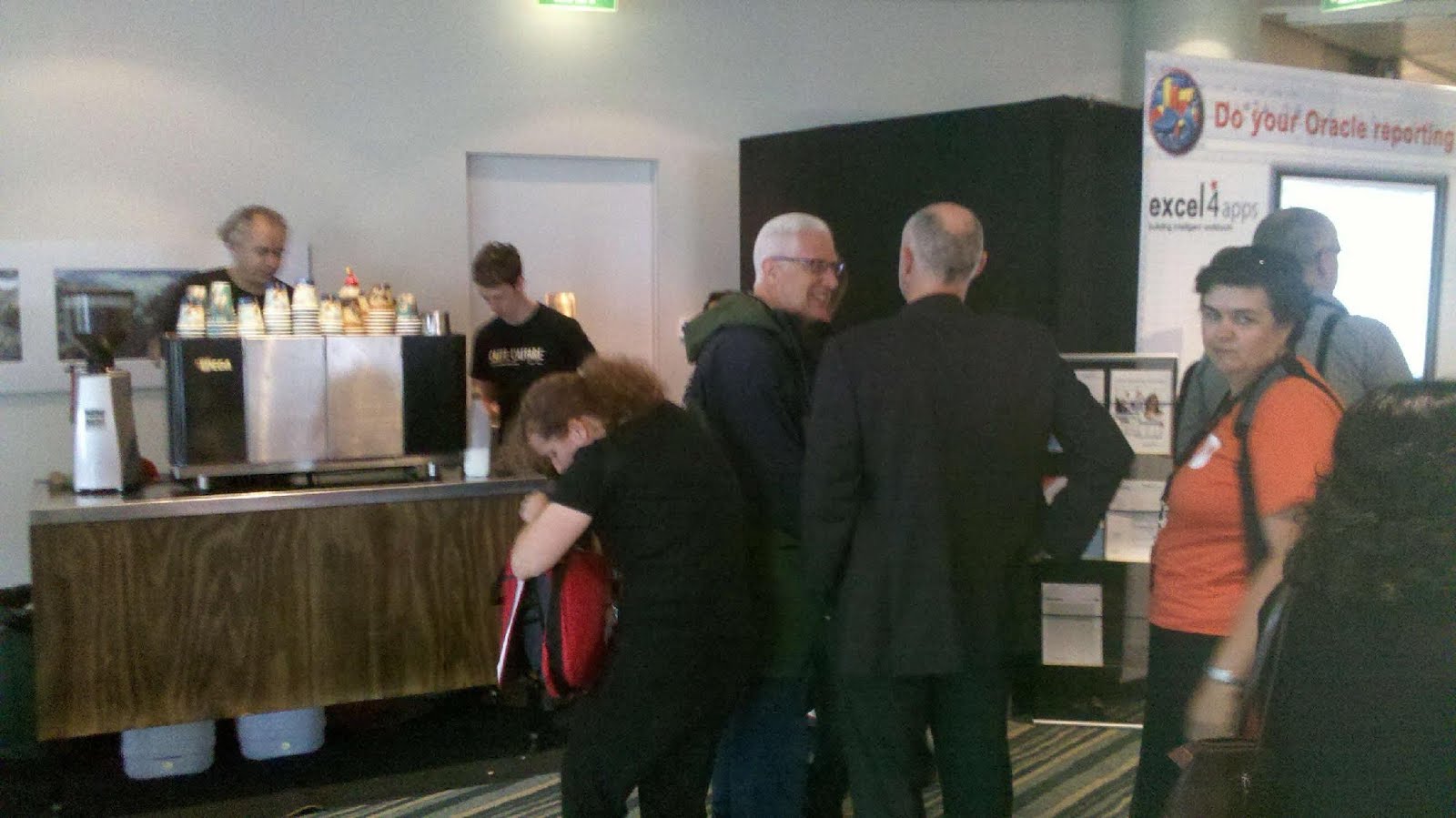
Just like Kscope, between sessions there’s the ability to walk the vendor booths. And of course the really important stuff is just below:
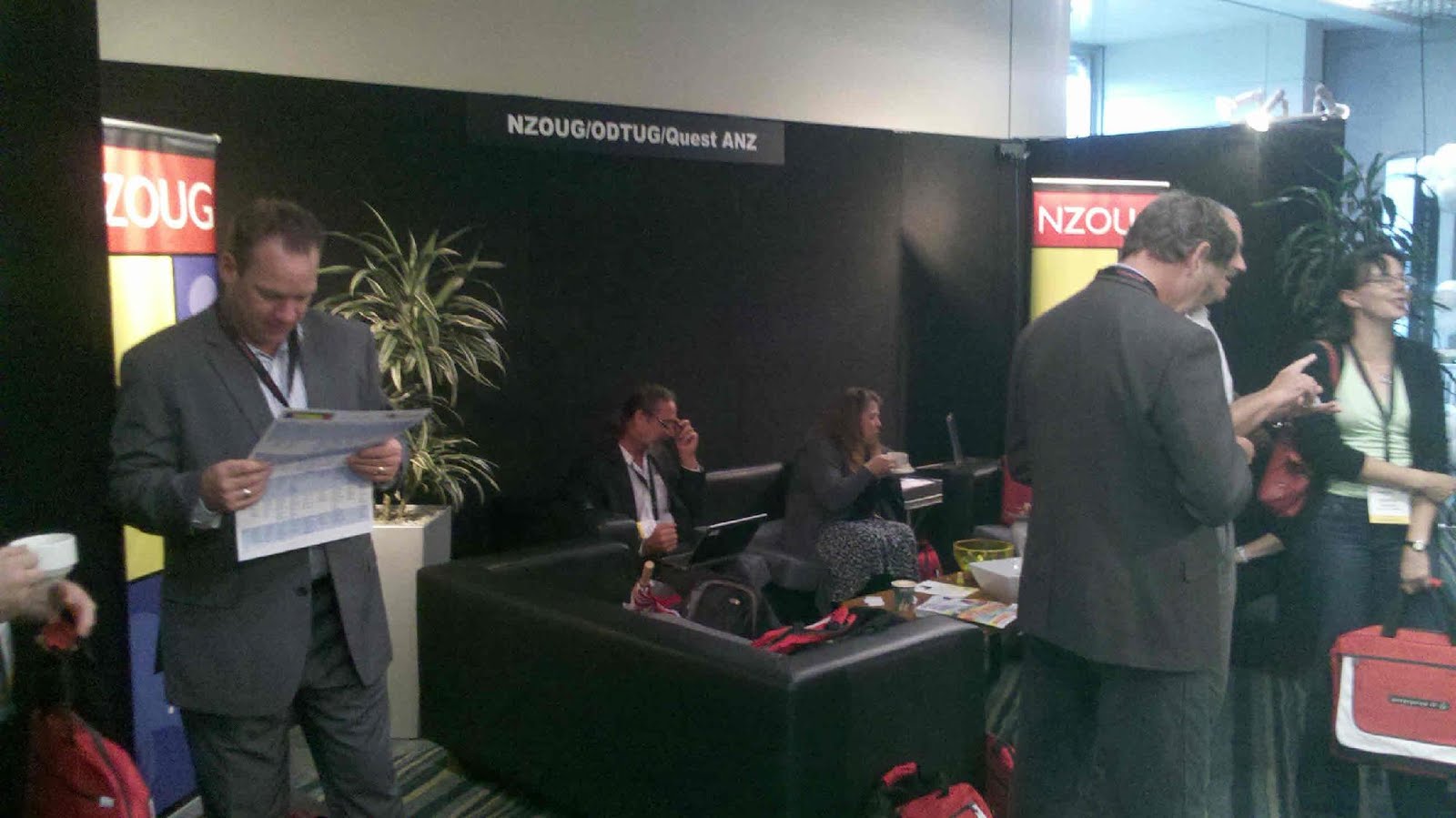
Flat blacks (Americanos, sort of), flat whites (café au laits, sort of), espresso, mmmmm. What was I here for again? Oh, right, NZOUG. And here’s the user group booth.

Babar Jan-Haleem, BI Futures, 11:10 am to 12:00 pm, NZDST

I begged, harangued, and bothered Bambi Price, and Erica Harris, and Kay Galbraith, and Babar Jan-Haleem himself to come to NZOUG and talk BI futures. Perhaps they all realized I wasn’t going to go away until he said “Yes”. And I quite happy to say that he is here, and is talking about BI futures. But what is this talk about Exalytics being anything more than the biggest and baddest Essbase box in the world? There’s more to life than Essbase? Apparently so.

Charles Pinda, Financial Results with EPM 11.1.2.2, 12:10 pm to 1:00 pm, NZDST

Ah, Oracle presales, but I like him. :) I kid, I kid. These guys are great – I have *tried* to do it and good grief is that hard to do (I might add that I ran away from it as fast as my little legs would take me). Implementation geeks like me cannot exist (or at least cannot earn a living) without guys like Charles and the sales reps he supports. And to be fair to them, they tend to have a much broader view of the tools, needs, the market, etc. than Essbase/Planning/ODI/whatever hackers tend to have. They have to speak to multiple products, multiple industries, and multiple customers, all at the same time.

So what’s this session all about? Smart View, for sure. And from an Essbase geek’s perspective, the fact that 11.1.2.2 has reached parity with the add-in, well…that’s it for me from a tool perspective now that I can seamlessly use Planning with Excel.

Project Financial Planning – the prebuilt colossus known as PFP (there is some really cool BSO and ASO integration behind the scense). Personally, from a Capex and even Workforce perspective, this has to be the future (no, that is not official Oracle-speak, just what appears to be obvious to me and of course I could be wrong). It’s focus is long term projects and yes, I have tried to do this in “normal” Planning and it is sort of a pain to do. Given its name, it isn’t super surprising that PFP is a better fit for this kind of Planning. Btw, this may either make you sad or jump for joy (I tend to be in the latter camp) – no EPMA.

Charles just talked about Decision Management – this is really cool – it’s a summary of budget requests with narrative justification and supporting detail. This is a new feature of Public Sector Planning and Budgeting aka PSPB as of 11.1.2.2. I don’t do PSPB but this is something that really ought to be in “normal” Planning IMHO.

Richard Philipson, Exploring Oracle BI Apps: How does it work and what do I get ?, 2:30 pm to 3:20 pm, NZDST

I know Richard from multiple Kscopes – now I’m sitting in on his BI Applications suite session. There are multiple apps around Sales, Financials, HR, Marketing, Procurement & Spend, Supply Chain – who knew? Not me. And that is why I come to conferences like this – the world I need to learn is large, the amount of information I actually know is really pretty small, something has to bridge the gap, ergo user conferences like NZOUG 2013.

And what makes up BI Apps? An ETL tool, a central console to manage anything, built in ETL adaptors, a unified data model, and reports – ta da, BI Apps.

Richard’s presentation is showing Informatica (I think that this is actually as the BI Apps packages are sold from Oracle which is a bit confusing although I could have it wrong) as the ETL tool, but ODI can be part of this as well, and that’s how the BI Apps hook into the transactional system. A data warehouse is at the center (hmm, should that be centre or is that just too twee for words?). Just like ODI, OBIEE has physical and logical layers hung off the DW to come up with reporting.

(Hmm, there’s a Q&A going on right now about the Informatica vs. ODI issue – it sounds like Informatica is the historical solution but the future is likely to be ODI.)

Yr. Obdnt. Srvnt., The spreadsheet management system known as Dodeca, 3:40 pm to 4:30 pm, NZDST

Hmm, tough to say if this was a success or not. Most of the presentations here tend not to be super technical, at least in the BI/EPM track. This presentation was pretty technical, and I’m not 100% sure I hit the mark with this one. OTOH, I did see people furiously scribbling down notes (although I have to wonder if they were writing down what needs to be related to the NZ Ministry of Health as I could be a hazard to the public when I am at full chat) as I ranted and raved (in a positive way) about Dodeca so maybe it wasn’t so bad. You decide – I’ve stuck the full presentation right here. This presentation is pretty big (34 megabytes) because of the embedded movies – You Have Been Warned.

Dan O’Brien, Oracle Business Intelligence: Model First, Build Later, 4:40 pm to 5:30 pm NZDST

High concept – Agile development with OBIEE.

Everything else concept – multiple techniques to quickly model business processes to OBIEE applications without going through a complex bottom-up build process.

This is pretty interesting stuff as Dan is talking about a bunch of different strategies about how to get round the formal, inflexible, “normal” way of developing OBI applications. Really the issues he’s talking about apply equally to EPM.

NB – One really funny comment in his presentation – “spreadmarts”. This is totally in line with my Dodeca presentation – you know your system/implementation/company is in trouble when really big spreadsheets become data marts. Spread + mart = spreadmart.

The end of today

Well, not really the end, but the end of what I’m going to blog for now. There’s a NZOUG event tonight at 7 pm and I hope to get a good sleep tonight. I have really totally given up trying to figure out what time it is, or what time my body thinks it is, and just think about strategies for blissful rest.

And that’s where I’m going to end this post.

Be seeing you.

Monday, February 18, 2013

I cover the Antipodes

Okay, technically they’re only the Antipodes if you live in England. And, if you look at a globe, it’s easy to tell that this is just a figure of speech, not a direction for a Journey To The Center Of The Earth. In fact, near as I can tell, China fits for the States if I were to transfer the analogy to where I live. And that makes sense because that movie about Three Mile Island was called The China Syndrome and not The New Zealand Syndrome. (True story – I can remember as a kid my parents sitting at the kitchen table trying to figure out where to bug out if York, PA became a radioactive wasteland. Fun times, fun times. This stuff is safe, right? Riiiiight.) Have I lost everyone? Hopefully not, because there is good stuff to come.

Anyway, I am not in the nuclear power industry (and that is a good thing given my sometimes decided lack of attention and focus) nor am I going to China, but yr. obdnt. srvnt. is going to both New Zealand and Australia for two conferences. Yes, I am a glutton for punishment but I was asked and I said “Yes” before anyone could change his mind.

New Zealand
The New Zealand Oracle Users Group has its conference every 18 months. NZOUG 2013 is from 18 to 19 March 2013 in Te Papa, Wellington, NZ. In theory, I was the content chairman for the BI and EPM track at this conference but I have to admit that this really meant that I bugged, bothered, and pestered Erica Harris, Richard Philipson, and what seems like most of Oracle Australia/New Zealand (thanks to Kay Galbraith and Daniel O’Brien) with trying to figure out what would be appropriate content for NZ and who oh who would present. They did a great job identifying people to speak. NZOUG does quality work and their agenda is very strong. I plan on checking out the other tracks (something I never seem to be able to do at Kscope) while I am there as well as presenting two sessions, one on ODI and data quality (hey, come to NZ or buy my book and read my chapter on this) and the other, excitingly, on Dodeca. Now I just have to finish writing it.

Check out the agenda here.

Here’s what’s planned for BI and EPM:

The important bits are: NZOUG 2013 is from 18 to 19 March in Te Papa, Wellington and costs a mere 795 +GST NZD if you are a member and register under the early bird scheme. Read the full agenda – there’s amazing value for money.

Australia
Ah, another country, and a slightly different group of people to exasperate, although in this case it’s fellow board member and Oracle ACE Bambi Price that I think I annoyed the most and of course Oracle Australia (hi, Kay, and yeah, I owe you). Again, I helped out with the agenda and yes, I have written about this before for the ODTUG blog where you can read all about it.

This is an ODTUG Seriously Practical conference (NZOUG is their own full Oracle product line show show, I am just there to present and help with the BI and EPM content selection) and as such will focus a deep dive into the technical end of the BI and EPM tools. Yes, I am presenting the same two sessions at this conference and no, there will not be many NZers (I just made that word up as “Kiwis” is a bit twee) in Melbourne so I don’t view this approach as a rerun. More like a keep-Cameron-on-the-ragged-edge-of-sanity-because-he-takes-too-much-on approach.

Check out the agenda here.

Here’s what’s planned for BI and EPM:

The important bits are: the ODTUG SP Australia is from 21 to 22 March in Melbourne and costs a mere 599 AUD. Read the full agenda – there’s amazing value for money. Again. 

This is pretty exciting stuff
Okay, the flight in economy from home to NZ to Aus to NZ to LA to home is not exciting. At all. But helping out with BI and EPM geeks on the other side of the world is exciting. Yes, they have odd sounding accents (of course to them I’m the one with the weird way of pronouncing things and the incomprehensible slang) but their passion and commitment to technical knowledge, sharing, and evangelism is just like what you see here in the States with ODTUG’s events. I’m beyond happy and proud to help out and I’m hoping that both events will be a great success.

Thanks to the magic of Google Analytics, I know that both NZ and Australia read this blog. Australasians, if you have ever wondered what kind of idiot I am in person, now’s your chance. :) Seriously, they’re both good presentations and you can always go get a cup of tea (ah, real tea, I wonder what the NZ/Aus. version of Typhoo or PG Tips is) if I prattle on too much. I hope that you’ll be able to come to the conference that is closest – as you can see from the above there’s really some great content on offer.

Be seeing you.

Popular Posts