Oh happy day! Hartford finally seems ready to spend billions, investing in our transportation system and the state’s economic future.
Last year, Governor Rell pushed the legislature to long overdue action, allocating $1.3 billion for new rail cars on Metro-North. This year she wants to spend another $600 million on mass transit in the I-91 corridor, including commuter rail from New Haven to Springfield and a busway from New Britain to Hartford.
Not to be outdone, the Democrats are going the Governor one better. House Speaker Jim Amann says its time the state spent $6.2 billion to fund all of the recommendations of the Transportation Strategy Board.
That’s amazingly good news. But where were our lawmakers when the TSB issued its recommendations three years ago? Why have the Democrats finally embraced this issue, which they ignored for decades? Answer… because unlike her predecessor, John Rowland, who said the TSB plan was d.o.a., Governor Rell embraced it and started moving it toward implementation. Thank heavens for party politics in an election year!
But both the Governor and the legislature are missing an important opportunity right now to improve another issue facing our state… jobs and the economy.
We are about to spend $1 billion on new rail cars for Metro-North, but as it stands, none of that money will benefit our state’s economy.
The Metro-North Commuter Council has reviewed the specifications for the new M8 cars as drawn up by the consulting firm LTK (under a no-bid contract to Metro-North). While the specs look great from an engineering viewpoint, it is clear they were drawn up with little involvement or influence from Connecticut DOT, as they favor Metro-North and New York state, not us.
The M8 project will mean jobs… for New York State, but not Connecticut. Though our taxpayers will pay two-thirds of the cost of the new cars, no provision has been made in the contract to see a dime of those funds earmarked for Connecticut.
The three qualified bidders on the M8 project… Bombardier, Kawasaki and Siemens… all have plants in NY State, but not in Connecticut. But shouldn’t Connecticut firms like United Technologies get a piece of the action, and support local jobs in the process?
The minority and women-owned business “set asides” in the M8 contract will total $50 million apiece. But read the spec’s drawn up for Metro-North, and you’ll only see mention of that spending in New York state, not Connecticut.
Metro-North is a vendor to CDOT. They’re hired to run “our” trains and are paid well for doing so. They do that job well. But we are turning over to our vendor the responsibility for the design and construction of a billion dollars worth of rail cars that we’re paying two-thirds of the cost for.
How could CDOT miss the chance to see our taxpayers’ money be spent for jobs and construction in our state? That’s a good question… and one which I hope those in legislative oversight will ask of CDOT staff.
----------------------------------------------------------------------
JIM CAMERON has been a commuter out of Darien for 15 years. He is Vice Chairman of the CT Metro-North / Shore Line East Rail Commuter Council, and a member of the Coastal Corridor TIA and the Darien RTM. You can reach him at jim@camcomm.com or www.trainweb.org/ct . For a full collection of “Talking Transportation” columns, see www.talkingtransportation.blogspot.com
Tuesday, February 14, 2006

Saturday, January 28, 2006
Fire On The Train
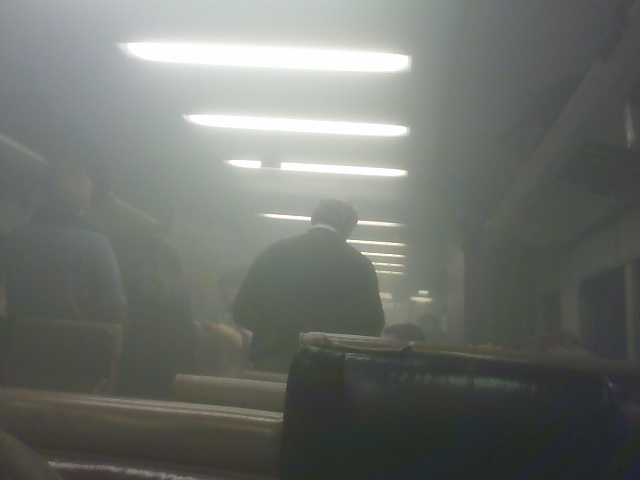
It was a typical Thursday, mid-afternoon, when Metro-North train #1540 pulled out of Grand Central on time at 3:34 pm, heading for New Haven. But this train’s journey on January 26th was to be anything but normal.
As recounted by an eye-witness, here is what happened.
Snaking its way through the underground yards, the train moved toward the Park Avenue tunnel when passengers in the fourth car of the eight car train started smelling smoke. Though they didn’t know it, a traction motor on the 1994-built M6 car, one of the newest in our aging fleet, had caught fire.
There were no flames, but there surely was smoke, not only in the fourth car but the three others that followed it. As that smoke grew thicker, being pumped into the cars by the ventilation system, passengers started coughing… and looking for help.
Because there is no intercom system on our trains, one of the passengers reached up to the ceiling and pushed the conductor buzzer system used to communicate with the motorman driving the train. A voice came over the PA system and, rather than explaining the smoke condition and what was being done to get help, told them to “lay off of the buzzer!”.
By now the train had stopped, still underground. A conductor moved forward, looking to trip the circuit-breakers for the burning motor and to shut off the HVAC fans still pumping acrid smoke into the cars. When that was finally accomplished, passengers were told to “move forward” to the unaffected cars. The train continued north through the tunnels to 125th Street.
Finally arriving at the above-ground station eight minutes later, the doors opened and the train was evacuated. Another train was dispatched from GCT to pick up the stranded passengers and they continued on their journey. There were no injuries but lots of rattled nerves.
This is at least the third such fire on Metro-North New Haven line trains in recent years. None got much publicity. Were it not for an eye-witness to this fire (who was also equipped with a cell-phone camera) who contacted the Commuter Council, this incident might never have gained attention. (Metro-North initially told me they had no reports of a fire… but there had been a “smoke condition”. Well, where there’s smoke…)
It will be at least two to three more years before our new M8 cars are in service, so what do I say to commuters who ask: Is it safe to ride Metro-North existing fleet of 30+ year old cars? What if this smoky fire had been a terrorist attack? Was “lay off the buzzer” the best the railroad could say to panicked passengers in a smoke-filled car? Will there be more such incidents, and if so, how can we handle them better?
The Commuter Council will be following up on this case with the authorities, and I’ll let you know what we find.
-----------------------------------------------------------------------
JIM CAMERON has been a commuter out of Darien for 14 years. He is Vice Chairman of the CT Metro-North / Shore Line East Rail Commuter Council, and a member of the Coastal Corridor TIA and the Darien RTM. You can reach him at jim@camcomm.com or www.trainweb.org/ct . For a full collection of “Talking Transportation” columns, see www.talkingtransportation.blogspot.com
Thursday, January 19, 2006
"Free Parking Isn't Free"
Our obsession with automobiles is not only creating gridlock and ruining the quality of our air, but its eating up our real estate and sending land costs upward. Because, once we drive our cars off the crowded highways, we assume it’s our constitutional right to find “free parking”.
For decades, city planners and zoning regulations have shared with Detroit in a conspiracy to deliver on that dream. Consider the following:
According to the industry standard-setting Institute of Transportation Engineers, there are 266 kinds of businesses which should be zoned to require a minimum amount of parking. Quoting from the ITE “bible”, convents must have one parking space for every ten nuns in residence. Hello? The residents aren’t going anywhere! Why do they need parking? Couldn’t the convents find better use for their land?
Or consider hotels. Why are parking regulations based on requiring enough parking for the few nights each year when the hotel is sold out, rather that the majority of nights when occupancy is 50% or less? Would we require a movie theater to require parking for an every-seat-filled blockbuster when its more typical offerings fill far fewer seats?
Just drive up the Post Rd and see for yourself. Due to zoning regulations, many shopping malls devote 60% of their land to parking and only 40% to buildings. Imagine what that does to the costs of what they sell.
Desperate to attract folks back to their decaying downtowns, some cities are putting more land into parking than to all other land uses combined. A Buffalo City Council member commented a few years ago: “There will be lots of places to park. There just won’t be a whole lot to do there.”
In fact, the cities that have done the best jobs of economic revlitalization aren’t the ones that provided the most parking… they’re the ones that provided the least. The vitality of towns and cities requires people… walking the streets, going into shops and interacting… not scurrying from car to shop to car to home.
In his new book “The High Cost of Free Parking”, UCLA’s Donald Shoup recounts the following tale of two cities:
Both San Francisco and LA opened new concert halls in recent years. The one in LA included a $10 million, six story parking garage for 2,100 cars. In San Francisco there was no parking built… saving the developers millions. After each concert, the LA crowd heads for their cars and drives away. But in San Francisco, patrons leave the hall, walk the streets and spend money in local restaurants, bars and bookstores. Guess which city has benefited most from its new arts center?
Why are Connecticut towns slaves to antiquated zoning mentalities that assume all humans come with four tires rather than two legs? Why do we waste precious land on often-empty parking spots instead of badly needed affordable housing?
Clearly, our transportation planners need to work much more closely with economic developers to rethink what it is that we need in our cities and towns. We have become mindless slaves to car-obsessed planners for whom no vista is better than miles of open asphalt, be it highways or parking spaces.
--------------------------------------------------------------
JIM CAMERON has been a commuter out of Darien for 14 years. He is Vice Chairman of the CT Metro-North / Shore Line East Rail Commuter Council, and a member of the Coastal Corridor TIA and the Darien RTM. You can reach him at jim@camcomm.com or www.trainweb.org/ct . For a full collection of “Talking Transportation” columns, see www.talkingtransportation.blogspot.com
For decades, city planners and zoning regulations have shared with Detroit in a conspiracy to deliver on that dream. Consider the following:
According to the industry standard-setting Institute of Transportation Engineers, there are 266 kinds of businesses which should be zoned to require a minimum amount of parking. Quoting from the ITE “bible”, convents must have one parking space for every ten nuns in residence. Hello? The residents aren’t going anywhere! Why do they need parking? Couldn’t the convents find better use for their land?
Or consider hotels. Why are parking regulations based on requiring enough parking for the few nights each year when the hotel is sold out, rather that the majority of nights when occupancy is 50% or less? Would we require a movie theater to require parking for an every-seat-filled blockbuster when its more typical offerings fill far fewer seats?
Just drive up the Post Rd and see for yourself. Due to zoning regulations, many shopping malls devote 60% of their land to parking and only 40% to buildings. Imagine what that does to the costs of what they sell.
Desperate to attract folks back to their decaying downtowns, some cities are putting more land into parking than to all other land uses combined. A Buffalo City Council member commented a few years ago: “There will be lots of places to park. There just won’t be a whole lot to do there.”
In fact, the cities that have done the best jobs of economic revlitalization aren’t the ones that provided the most parking… they’re the ones that provided the least. The vitality of towns and cities requires people… walking the streets, going into shops and interacting… not scurrying from car to shop to car to home.
In his new book “The High Cost of Free Parking”, UCLA’s Donald Shoup recounts the following tale of two cities:
Both San Francisco and LA opened new concert halls in recent years. The one in LA included a $10 million, six story parking garage for 2,100 cars. In San Francisco there was no parking built… saving the developers millions. After each concert, the LA crowd heads for their cars and drives away. But in San Francisco, patrons leave the hall, walk the streets and spend money in local restaurants, bars and bookstores. Guess which city has benefited most from its new arts center?
Why are Connecticut towns slaves to antiquated zoning mentalities that assume all humans come with four tires rather than two legs? Why do we waste precious land on often-empty parking spots instead of badly needed affordable housing?
Clearly, our transportation planners need to work much more closely with economic developers to rethink what it is that we need in our cities and towns. We have become mindless slaves to car-obsessed planners for whom no vista is better than miles of open asphalt, be it highways or parking spaces.
--------------------------------------------------------------
JIM CAMERON has been a commuter out of Darien for 14 years. He is Vice Chairman of the CT Metro-North / Shore Line East Rail Commuter Council, and a member of the Coastal Corridor TIA and the Darien RTM. You can reach him at jim@camcomm.com or www.trainweb.org/ct . For a full collection of “Talking Transportation” columns, see www.talkingtransportation.blogspot.com
Sunday, January 8, 2006
The Lessons of California
While we all love to mock what passes for traffic in California, the Golden State is making progress in improving its transportation mess and may even give us a few ideas. Consider the following, which I recently observed on a trip west:
1) Commuter Rail & Amtrak: The trains are full, schedules are frequent and ridership is still climbing. Clean, modern, low-cost commuter trains in the LA area are so popular the operating agency is scouring the country looking for used rail cars to add to their fleet. Maybe they’d like some of our used Virginia cars, still sitting idle on a siding in New Haven?
2) Trolleys: You can now get from Long Beach to Pasadena by trolley, not to mention the subway from downtown to Hollywood. The trains are fast and gaining in ridership. In San Diego, the trolley now has three lines, including the popular run to the Mexico border. Cars crossing back into the US wait up to two hours to clear Customs while pedestrians cross in ten minutes.
3) Freeways: Yes, they’re crowded, but they’re well signed and drivers obey the traffic rules. Best of all, there are few trucks in rush hour as they are offered incentives to move their goods at night.
4) Electric Cars: No longer are big muscle cars or exotic foreign sports cars the prestige ride. Now, its electric cars. Not only is the gas mileage better but they get priority parking spaces and can travel in car pool lanes with only one passenger.
5) Traffic Information: In the San Francisco Bay area, you can dial 511 on any cellphone and get instant traffic information. Tell the automated system your starting point, destination and desired route and you’ll get the latest information on travel times and any delays. Connecticut lawmakers have been calling for a similar system here for years, to no avail.
6) Reversible Lanes: San Diego has had reversible rush-hour lanes on some freeways for more than a decade… in-bound in the AM, outbound in the PM. We have nothing similar in Connecticut.
7) Toll Roads: Not all freeways are free. Some of the most heavily traveled roads in LA are private toll-roads, by-passing the free interstates. Fares are collected electronically without stopping and can be changed, depending on demand. While “value pricing” is already in effect in New Jersey and on the George Washington Bridge, we in Connecticut don’t yet have the political will to embrace this solution to our highway mess.
8) Air Quality: Despite the immense number of cars on the roads, stiff environmental regulations, in place for many years, California has significantly reduced air pollution. Many days the air is cleaner in LA than along I-95 in Stamford.
All is not perfect in the Golden State. And their 12 lane freeways are not a solution I’d suggest we consider. But next time you joke about “LA style traffic”, think twice. Pretty soon they’ll be joking about us!
-------------------------------------------------------------------------------
JIM CAMERON has been a commuter out of Darien for 14 years. He is Vice Chairman of the CT Metro-North / Shore Line East Rail Commuter Council, and a member of the Coastal Corridor TIA and the Darien RTM. You can reach him at jim@camcomm.com or www.trainweb.org/ct . For a full collection of “Talking Transportation” columns, see http://www.talkingtransportation.blogspot.com/
1) Commuter Rail & Amtrak: The trains are full, schedules are frequent and ridership is still climbing. Clean, modern, low-cost commuter trains in the LA area are so popular the operating agency is scouring the country looking for used rail cars to add to their fleet. Maybe they’d like some of our used Virginia cars, still sitting idle on a siding in New Haven?
2) Trolleys: You can now get from Long Beach to Pasadena by trolley, not to mention the subway from downtown to Hollywood. The trains are fast and gaining in ridership. In San Diego, the trolley now has three lines, including the popular run to the Mexico border. Cars crossing back into the US wait up to two hours to clear Customs while pedestrians cross in ten minutes.
3) Freeways: Yes, they’re crowded, but they’re well signed and drivers obey the traffic rules. Best of all, there are few trucks in rush hour as they are offered incentives to move their goods at night.
4) Electric Cars: No longer are big muscle cars or exotic foreign sports cars the prestige ride. Now, its electric cars. Not only is the gas mileage better but they get priority parking spaces and can travel in car pool lanes with only one passenger.
5) Traffic Information: In the San Francisco Bay area, you can dial 511 on any cellphone and get instant traffic information. Tell the automated system your starting point, destination and desired route and you’ll get the latest information on travel times and any delays. Connecticut lawmakers have been calling for a similar system here for years, to no avail.
6) Reversible Lanes: San Diego has had reversible rush-hour lanes on some freeways for more than a decade… in-bound in the AM, outbound in the PM. We have nothing similar in Connecticut.
7) Toll Roads: Not all freeways are free. Some of the most heavily traveled roads in LA are private toll-roads, by-passing the free interstates. Fares are collected electronically without stopping and can be changed, depending on demand. While “value pricing” is already in effect in New Jersey and on the George Washington Bridge, we in Connecticut don’t yet have the political will to embrace this solution to our highway mess.
8) Air Quality: Despite the immense number of cars on the roads, stiff environmental regulations, in place for many years, California has significantly reduced air pollution. Many days the air is cleaner in LA than along I-95 in Stamford.
All is not perfect in the Golden State. And their 12 lane freeways are not a solution I’d suggest we consider. But next time you joke about “LA style traffic”, think twice. Pretty soon they’ll be joking about us!
-------------------------------------------------------------------------------
JIM CAMERON has been a commuter out of Darien for 14 years. He is Vice Chairman of the CT Metro-North / Shore Line East Rail Commuter Council, and a member of the Coastal Corridor TIA and the Darien RTM. You can reach him at jim@camcomm.com or www.trainweb.org/ct . For a full collection of “Talking Transportation” columns, see http://www.talkingtransportation.blogspot.com/
Thursday, December 22, 2005
Going First Class
For a guy who writes so much about transportation, trust me, I’m something of a homebody. I don’t like to travel anymore. Not that I don’t enjoy visiting different cities (and do so almost weekly for business), it’s just that the journey from here to there is not much fun anymore. Whoever said “getting there is half the fun” hasn’t flown lately.
Getting to and from the airport is a major hassle and expense. Airports (and planes) are jammed. Getting through security is like visit a proctologist. Flights are inevitably delayed. Meals enroute are but a memory. Frequent flyer programs have whored themselves, passing out “elite” status to so many passengers that it’s impossible to get an upgrade, let alone a free ticket.
But there is an alternative: first class… or at least business class on transcon flights. Sure, it costs more… either in higher fares or in redeeming those once precious frequent flyer miles… but it’s worth it.
You get to check in faster. The seats are bigger. The flight attendants are actually friendly. And they give you real food. Plus, there’s that slightly smug feeling as you ease into your seat and watch the coach customers walk in, heading for steerage, that you’re, well, “special”.
Even on Amtrak, first class is a better experience. On Acela to Boston or Washington there’s a comfier seat and a decent meal. (I don’t drink, so the free booze in flight or on the train matters little to me). And, unlike the airlines with their pricey airport “clubs”, first class passengers can use Amtrak’s “Metropolitan Lounge” (now dubbed “Club Acela”), complete with wi-fi and free beverages.
What may surprise you is that going first class doesn’t always mean taking out a home equity loan. In fact, compared to full fare coach, first is often only a few bucks more.
There’s a great Norwalk-headquartered travel meta-search engine, www.kayak.com that allows you to price all your alternatives, coach / business / first, at one site, so you’ll see the hidden bargains. (Full disclosure: Kayak is a consulting client of mine… but trust me, I wouldn’t recommend them if I didn’t think they were great). I always trust a neutral website even more than a commission-incentivized travel agent.
Does this mean I’ve abandoned Jet Blue or Song? No way, especially when I’m traveling with my family. But my New Year’s resolution for business travel is “treat myself right.” Life is too short to be trapped in coach.
I am reminded of a bumper sticker I saw once at a TWA ticket office. It read: “Fly First Class… Your Heirs Will”.
-----------------------------------------------------------------------------------------------------
JIM CAMERON has been a commuter out of Darien for 14 years. He is Vice Chairman of the CT Metro-North / Shore Line East Rail Commuter Council, and a member of the Coastal Corridor TIA and the Darien RTM. You can reach him at jim@camcomm.com or www.trainweb.org/ct . For a full collection of “Talking Transportation” columns, see www.talkingtransportation.blogspot.com
Getting to and from the airport is a major hassle and expense. Airports (and planes) are jammed. Getting through security is like visit a proctologist. Flights are inevitably delayed. Meals enroute are but a memory. Frequent flyer programs have whored themselves, passing out “elite” status to so many passengers that it’s impossible to get an upgrade, let alone a free ticket.
But there is an alternative: first class… or at least business class on transcon flights. Sure, it costs more… either in higher fares or in redeeming those once precious frequent flyer miles… but it’s worth it.
You get to check in faster. The seats are bigger. The flight attendants are actually friendly. And they give you real food. Plus, there’s that slightly smug feeling as you ease into your seat and watch the coach customers walk in, heading for steerage, that you’re, well, “special”.
Even on Amtrak, first class is a better experience. On Acela to Boston or Washington there’s a comfier seat and a decent meal. (I don’t drink, so the free booze in flight or on the train matters little to me). And, unlike the airlines with their pricey airport “clubs”, first class passengers can use Amtrak’s “Metropolitan Lounge” (now dubbed “Club Acela”), complete with wi-fi and free beverages.
What may surprise you is that going first class doesn’t always mean taking out a home equity loan. In fact, compared to full fare coach, first is often only a few bucks more.
There’s a great Norwalk-headquartered travel meta-search engine, www.kayak.com that allows you to price all your alternatives, coach / business / first, at one site, so you’ll see the hidden bargains. (Full disclosure: Kayak is a consulting client of mine… but trust me, I wouldn’t recommend them if I didn’t think they were great). I always trust a neutral website even more than a commission-incentivized travel agent.
Does this mean I’ve abandoned Jet Blue or Song? No way, especially when I’m traveling with my family. But my New Year’s resolution for business travel is “treat myself right.” Life is too short to be trapped in coach.
I am reminded of a bumper sticker I saw once at a TWA ticket office. It read: “Fly First Class… Your Heirs Will”.
-----------------------------------------------------------------------------------------------------
JIM CAMERON has been a commuter out of Darien for 14 years. He is Vice Chairman of the CT Metro-North / Shore Line East Rail Commuter Council, and a member of the Coastal Corridor TIA and the Darien RTM. You can reach him at jim@camcomm.com or www.trainweb.org/ct . For a full collection of “Talking Transportation” columns, see www.talkingtransportation.blogspot.com
Monday, December 12, 2005
Metro-North's Report Card: D+
Riders on Metro-North have just given the railroad its annual report card:
For performance D+
For effort a B+
For personality an A.
The annual Customer Satisfaction Survey taken by the railroad (in cooperation with the Commuter Council) was conducted last September, before the wires-down problems occurred and well in advance of the winter snows. (By the way… the railroad used to conduct quarterly surveys but now stakes its reputation on annual audits of its customers. They even chose to skip the survey one year because of a fare hike and expected bad grades. Wouldn’t we all wish we could be evaluated like this?)
Grades from riders on the Hudson and Harlem lines continued to soar as they enjoy riding in their new M7 cars. Meanwhile, their rich country cousins in Connecticut struggle on with cars older than many riders… 30+ years.
These grades from New Haven line riders don’t paint a pretty picture:
Overall satisfaction with conditions on the train: 76%, down 2% from 2004… and pathetic compared to 95% on Hudson and Harlem trains.
Availability of seats: 62% satisfied, down 5 %.
Cleanliness of floors: 66% satisfied.
Cleanliness of restrooms: 44% satisfied.
To be fair, the railroad did make better than passing grades in other categories:
On time performance: 89% satisfied.
Grand Central Terminal: 97% satisfied.
Courtesy and responsiveness of employees, 97% satisfied.
What can be done to improve these ratings? Plenty… but they’ll all take time. It won’t be until 2009 that we’ll start taking delivery of our new M8 cars to ease crowding and increase reliability.
For years now, my mantra has been “things are going to get a lot worse on Metro-North before they get any better”… which is not to say that things aren’t being done today to help.
Almost a hundred of our oldest cars, the M2’s, have gone through the CSR, or “Critical Systems Replacement”, program. They’ve had their engineering guts ripped out and replaced, and their reliability has soared. But from the passengers’ perspective, those cars look pretty much the same inside, so few appreciate the investment… especially when they pull into Grand Central and across the platform is a shiny set of high-tech M7 cars.
Sure, we’ll probably have a few more tough winters of delays and over-crowding, but that’s neither Mother Nature’s nor Metro-North’s fault. We can only blame ourselves and our lawmakers for letting the railroad slide so far downhill before attacking the problem.
The real question is… have we learned our lesson? Will we continue to invest in mass transit, and in doing so, our economy… or will we wait for another crisis?
-----------------------------------------------------------------------------------------------------
JIM CAMERON has been a commuter out of Darien for 14 years. He is Vice Chairman of the CT Metro-North / Shore Line East Rail Commuter Council, and a member of the Coastal Corridor TIA and the Darien RTM. You can reach him at jim@camcomm.com or www.trainweb.org/ct . For a full collection of “Talking Transportation” columns, see www.talkingtransportation.blogspot.com
For performance D+
For effort a B+
For personality an A.
The annual Customer Satisfaction Survey taken by the railroad (in cooperation with the Commuter Council) was conducted last September, before the wires-down problems occurred and well in advance of the winter snows. (By the way… the railroad used to conduct quarterly surveys but now stakes its reputation on annual audits of its customers. They even chose to skip the survey one year because of a fare hike and expected bad grades. Wouldn’t we all wish we could be evaluated like this?)
Grades from riders on the Hudson and Harlem lines continued to soar as they enjoy riding in their new M7 cars. Meanwhile, their rich country cousins in Connecticut struggle on with cars older than many riders… 30+ years.
These grades from New Haven line riders don’t paint a pretty picture:
Overall satisfaction with conditions on the train: 76%, down 2% from 2004… and pathetic compared to 95% on Hudson and Harlem trains.
Availability of seats: 62% satisfied, down 5 %.
Cleanliness of floors: 66% satisfied.
Cleanliness of restrooms: 44% satisfied.
To be fair, the railroad did make better than passing grades in other categories:
On time performance: 89% satisfied.
Grand Central Terminal: 97% satisfied.
Courtesy and responsiveness of employees, 97% satisfied.
What can be done to improve these ratings? Plenty… but they’ll all take time. It won’t be until 2009 that we’ll start taking delivery of our new M8 cars to ease crowding and increase reliability.
For years now, my mantra has been “things are going to get a lot worse on Metro-North before they get any better”… which is not to say that things aren’t being done today to help.
Almost a hundred of our oldest cars, the M2’s, have gone through the CSR, or “Critical Systems Replacement”, program. They’ve had their engineering guts ripped out and replaced, and their reliability has soared. But from the passengers’ perspective, those cars look pretty much the same inside, so few appreciate the investment… especially when they pull into Grand Central and across the platform is a shiny set of high-tech M7 cars.
Sure, we’ll probably have a few more tough winters of delays and over-crowding, but that’s neither Mother Nature’s nor Metro-North’s fault. We can only blame ourselves and our lawmakers for letting the railroad slide so far downhill before attacking the problem.
The real question is… have we learned our lesson? Will we continue to invest in mass transit, and in doing so, our economy… or will we wait for another crisis?
-----------------------------------------------------------------------------------------------------
JIM CAMERON has been a commuter out of Darien for 14 years. He is Vice Chairman of the CT Metro-North / Shore Line East Rail Commuter Council, and a member of the Coastal Corridor TIA and the Darien RTM. You can reach him at jim@camcomm.com or www.trainweb.org/ct . For a full collection of “Talking Transportation” columns, see www.talkingtransportation.blogspot.com
A Holiday Bonus From Metro-North
Just in time for the holidays, commuters are getting a transportation bonus.
After years of singing the deficit blues, the MTA has found itself with an embarrassing $1 billion surplus at the end of the year. Rather than plowing that money into badly needed new rail cars, service and security improvements, the MTA Board has endorsed a “Let them eat (Christmas) cake” policy by returning $60 million of that money to riders in the form of lower fares.
From Thanksgiving through New Year’s, riders of Metro-North, Shore Line East and the MTA’s subways and buses will get significant discounts.
If you buy a monthly commutation ticket on Metro-North in December, you’ll get one free ten-trip, off-peak ticket good anywhere on the system. Buy a weekly or ten-trip ticket anytime from November 24th through December 27th and you’ll get one round-trip off-peak ticket.
On weekends from Thanksgiving through January 2nd, subway and bus fares in New York City will be half-fare, a dollar per ride. There’s even a 40-day unlimited ride MetroCard available for use November 23rd through January 2nd for $76 (cash only at ticket booths, while supplies last).
To accommodate the expected surge in ridership, Metro-North is adding a number of weekend “Shoppers Specials” trains, shown in red in your timetables. Full details of all these special fare bonuses can be found at www.mta.info . Even still, I’m predicting uncomfortable crowding on most trains in the coming weeks.
I hate to sound like Scrooge, but appeasing unhappy commuters with one-off holiday treats may not be the best use of our money. While flush with cash today, MTA is facing serious budget problems in the years ahead including a $2.2 billion shortfall in pension investments.
As Andrew Albert of the NY Transit Rider’s Council put it…”I'm not convinced that a two-week feel-good holiday give-back is perhaps the best gift for riders. Many have expressed to us that if you pay down more pension debt you create less of a drag on fares." Keep that in mind when MTA and CDOT seek their next fare increase.
Finally, a correction to last week’s column “Connecticut Commuters Lose Again”. While I was accurate in reporting that Connecticut gets only a half-million dollars out of the $37.5 million allocated by Homeland Security for rail safety in the tri-state region, I was wrong in assessing blame for that allocation. It was not Congressman Chris Shays who dropped the ball, but CDOT. Turns out that, after the money was allocated by Congress, it was up to the rail agencies… MTA, NJ Transit and CDOT, not Shays… to divide the pie. I apologize for getting the facts wrong.
-----------------------------------------------------------------------------------------------------
JIM CAMERON has been a commuter out of Darien for 14 years. He is Vice Chairman of the CT Metro-North / Shore Line East Rail Commuter Council, and a member of the Coastal Corridor TIA and the Darien RTM. You can reach him at jim@camcomm.com or www.trainweb.org/ct . For a full collection of “Talking Transportation” columns, see www.talkingtransportation.blogspot.com
After years of singing the deficit blues, the MTA has found itself with an embarrassing $1 billion surplus at the end of the year. Rather than plowing that money into badly needed new rail cars, service and security improvements, the MTA Board has endorsed a “Let them eat (Christmas) cake” policy by returning $60 million of that money to riders in the form of lower fares.
From Thanksgiving through New Year’s, riders of Metro-North, Shore Line East and the MTA’s subways and buses will get significant discounts.
If you buy a monthly commutation ticket on Metro-North in December, you’ll get one free ten-trip, off-peak ticket good anywhere on the system. Buy a weekly or ten-trip ticket anytime from November 24th through December 27th and you’ll get one round-trip off-peak ticket.
On weekends from Thanksgiving through January 2nd, subway and bus fares in New York City will be half-fare, a dollar per ride. There’s even a 40-day unlimited ride MetroCard available for use November 23rd through January 2nd for $76 (cash only at ticket booths, while supplies last).
To accommodate the expected surge in ridership, Metro-North is adding a number of weekend “Shoppers Specials” trains, shown in red in your timetables. Full details of all these special fare bonuses can be found at www.mta.info . Even still, I’m predicting uncomfortable crowding on most trains in the coming weeks.
I hate to sound like Scrooge, but appeasing unhappy commuters with one-off holiday treats may not be the best use of our money. While flush with cash today, MTA is facing serious budget problems in the years ahead including a $2.2 billion shortfall in pension investments.
As Andrew Albert of the NY Transit Rider’s Council put it…”I'm not convinced that a two-week feel-good holiday give-back is perhaps the best gift for riders. Many have expressed to us that if you pay down more pension debt you create less of a drag on fares." Keep that in mind when MTA and CDOT seek their next fare increase.
Finally, a correction to last week’s column “Connecticut Commuters Lose Again”. While I was accurate in reporting that Connecticut gets only a half-million dollars out of the $37.5 million allocated by Homeland Security for rail safety in the tri-state region, I was wrong in assessing blame for that allocation. It was not Congressman Chris Shays who dropped the ball, but CDOT. Turns out that, after the money was allocated by Congress, it was up to the rail agencies… MTA, NJ Transit and CDOT, not Shays… to divide the pie. I apologize for getting the facts wrong.
-----------------------------------------------------------------------------------------------------
JIM CAMERON has been a commuter out of Darien for 14 years. He is Vice Chairman of the CT Metro-North / Shore Line East Rail Commuter Council, and a member of the Coastal Corridor TIA and the Darien RTM. You can reach him at jim@camcomm.com or www.trainweb.org/ct . For a full collection of “Talking Transportation” columns, see www.talkingtransportation.blogspot.com
Subscribe to:
Posts (Atom)
Popular Posts
-
What happens when a good idea goes bad? Consider Metro-North’s “Quiet Car” initiative. Sixteen years ago a group of regular commuters on Am...
-
Today we start a new venture on behalf of my fellow Metro-North commuters: The Commuter Action Group To capture the mood of the moment and ...
-
The Road to Hell Are paved with such high and alas obviously unrealistic hopes for myself when it comes to live blogging. I’m not sure if i...
-
Oracle Open World 2016, Day 2 Today is the first “real” day of the conference in that today we’re seeing Oracle’s sessions. I’m particularly...
-
The real start of the conference Saturday is fun day. Sunday through Thursday are work days. I can’t decide which I prefer. Sadly, I thin...
-
 Despite what you may think, I don’t hate Metro-North. Sure, I am outspoken about its many failings, but always with a goal of making it bet...
 -
EPM in Massachusetts Another EPM meetup, another success. Monotonous, isn’t it? Here’s Mark Rinaldi and Norman Williams kicking off th...
-
Another year, another week of live blogging madness… …that goes by the name Oracle Open World. Yes, it’s here – here being San Francisco, t...
-
Riders on Metro-North just got an early holiday gift from the railroad and CDOT: a bright, shiny new train set… not toy, but real! We’ve...
-
It all began one summer It seems so long ago (2,770 days or 396 weeks or 91 months or 7.6 years – but who’s counting?) that I first put pen ...


